


Category III Emotions: Compound Interactive Emotions
This is the ninth article in a series of twelve and gives an overview of Category III Emotions, Compound Interactive Emotions in Affect Engineering, which include Benevolence, Malevolence, Jealousy, and Envy. It is designed for the layperson and explains the basics of Affect Engineering as a theory of emotions. Each article will begin with a list of questions that it will aim to address. The sections that follow will be in two parts each. The first part will be a short statement that answers each question as succinctly as possible. The second part will either be an explanation that goes into more detail where needed or explain some of the implications of the short answer.
QUESTIONS
- What are the Category Three Emotions in Affect Engineering?
- Why and how are conceptions of Jealousy and Envy altered to fit into Affect Engineering’s framework?
- What are Indulgent Type and Protective Type Category Three Emotions and why is there a distinction between them in Affect Engineering?
- What makes Category Three Emotions valuable to an individual?
1) What are the Category Three Emotions in Affect Engineering?
SHORT ANSWER
The Category Three Emotions, termed the Compound Interactive Emotions, consist of Benevolence, Malevolence, Jealousy, and Envy.
IN DEPTH EXPLANATION
Benevolence, Malevolence, Jealousy, and Envy are the four Category Three Emotions in Affect Engineering’s framework. Each involves empathy and they are considered compound in the sense that they are essentially comprised of a Category One Emotion (i.e., Intra-personal or Emotion of the Self) and a Category Two Emotion (i.e., Inter-personal or one of the Four Degrees of Empathy) and they often have implications for the outcomes of other goals held by the self and those around them. The self, however, has the ability to influence the outcome of the empathized party’s situation for Category Three Emotions, which is the primary distinguishing feature between this Category (i.e., Compound Interactive) and Category Two Emotions. The 1:1:1:1 Ratio in Affect Engineering is still upheld, as a 2:2:2:2 ratio because the self imagines itself as the targeted other and also identifies as themself, two entities are being valued for two separate purposes (one held be the self and the other for the target of empathy), and two emotions are being felt, one for the self and the other vicariously experienced as the targeted other. Article Two in this series, Reframing Anxiety as a Resource (Article 2 of 12), Question #4, offers more detail on the 1:1:1:1 Ratio.
The four Category Three Emotions are further classified as either Indulgent or Protective depending on the self’s Appraisal of an entity. In this case, the entity that the self is evaluating is the targeted party’s goal and whether the self wants them to succeed or fail. The Appraisal of an entity in Affect Engineering concerns whether further acquisition of the entity will lead towards or away from balance between a goal and its complementary goal, or homeostasis. Article Three in this series, Cognitive Appraisals in the Context of Affect Engineering (Article 3 of 12), offers more detail on Appraisals. When applied to Category Three Emotions that involve empathy, this becomes the self’s assessment as to whether or not the self successfully helping the targeted party fulfill a purpose will lead towards or away from equilibrium between a purpose and its complementary purpose for both the self and other. Indulgent Category Three Emotions have a negative Appraisal, while Protective Category III Emotions have a positive Appraisal. The chart below outlines basic forms of Category Three Emotions.
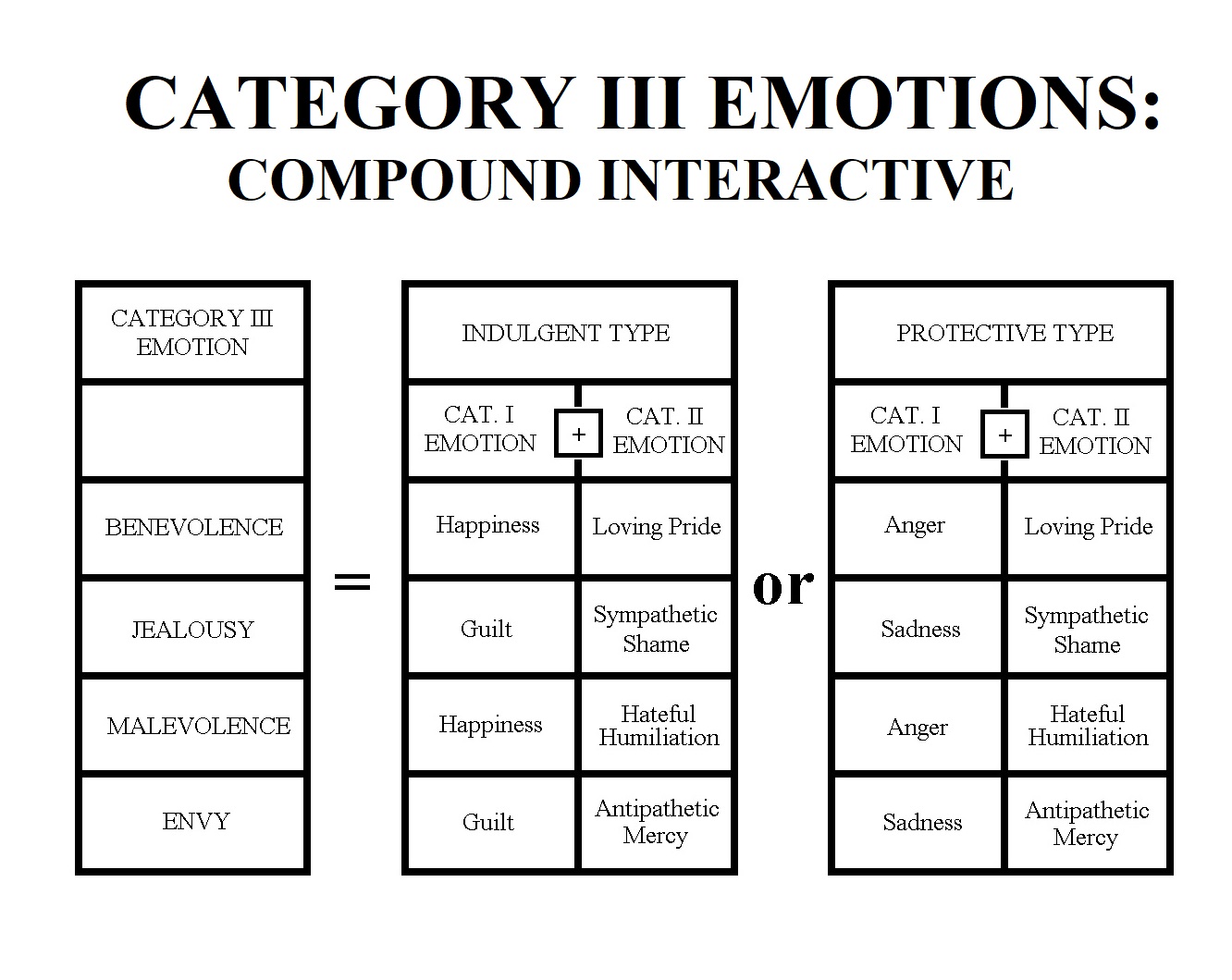
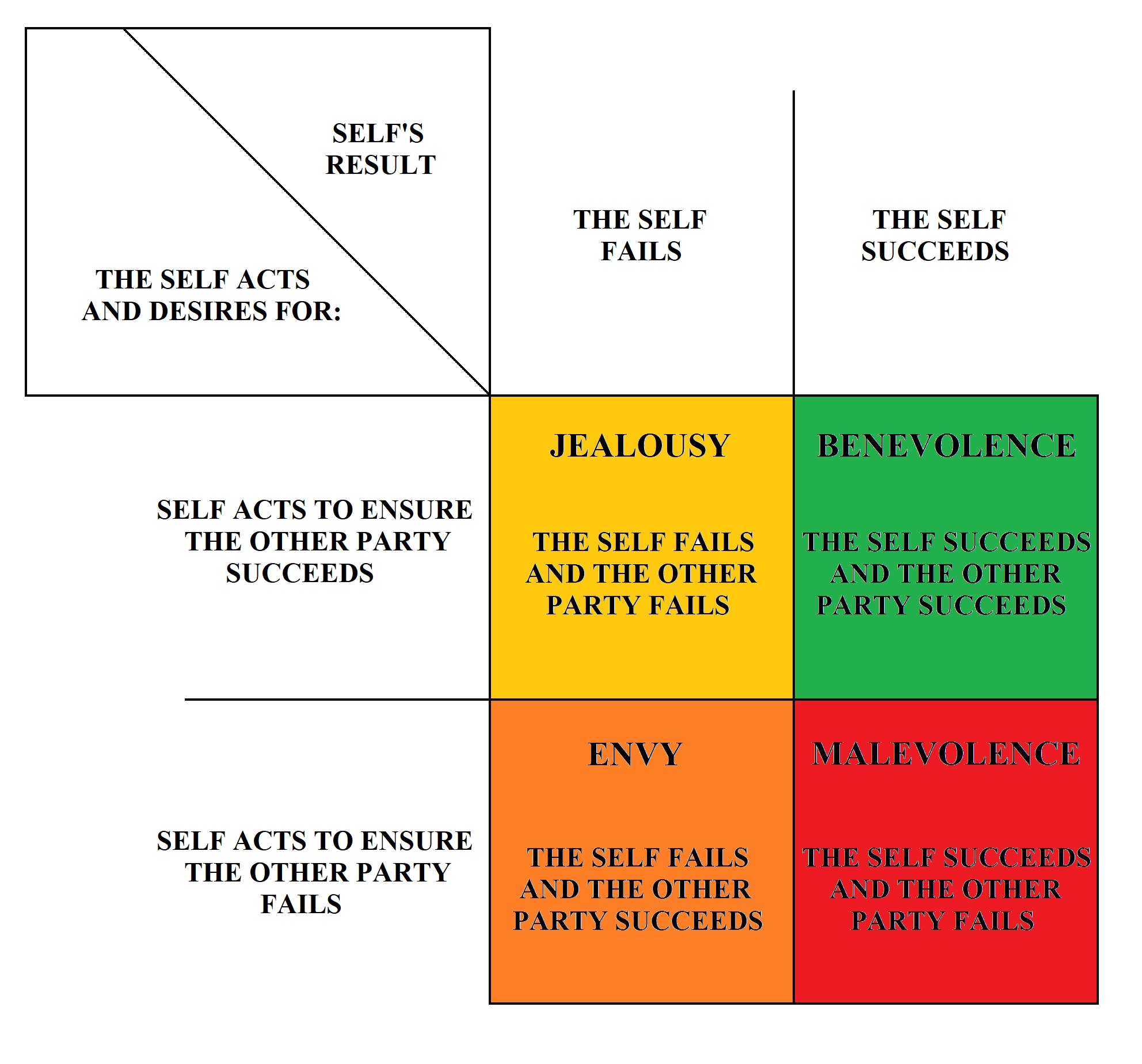
The core features of each Category Three Emotion in Affect Engineering are as follows:
- Benevolence: The self wants a targeted other party (i.e. target of the empathy) to succeed at a goal or purpose. The self takes action to help the targeted other party achieve their goal and is successful. Both the self and the targeted other party are successful.
- Jealousy: The self wants a targeted other party to succeed at a goal or purpose. The self takes action to help the targeted other achieve their goal but is unsuccessful. Both the self and the targeted other are unsuccessful.
- Malevolence: The self wants a targeted other party to fail at a goal or purpose. The self takes action to ensure that the targeted other party does not achieve their goal and the self is successful. The targeted other party fails at their objective, but the self is successful.
- Envy: The self wants a targeted other party to fail at a goal or purpose. The self takes action to ensure that the targeted other party does not achieve their goal but the self is unsuccessful. The targeted other party achieves their objective while the self, consequently, fails at their objective.
2) Why and how are conceptions of Jealousy and Envy altered to fit into Affect Engineering’s framework?
SHORT ANSWER
Many definitions of jealousy and envy are too broad in their scope and they inadvertently violate the 1:1:1:1 Ratio that Affect Engineering adheres towards when implemented directly. Therefore, only the minimal components of Jealousy and Envy considered in Affect Engineering. For Jealousy, this core component would be the fear of losing the target’s loyalty (e.g., typically precipitated by a failure by the self in some manner) and this is irrespective of any particular rival threatening to take it. For Envy, this core component would be contempt for another’s gain (such as that of a rival), or distress at the advantages or fortune enjoyed by another, and this is irrespective of any desire by the self desire to have that fortune or advantage for themself.
IN DEPTH EXPLANATION
In popular usage, jealousy and envy are often conflated with one another and mistakenly used as if they are interchangeable, typically to convey the idea of wanting something that another person has. The nuances between them, fortunately, are more clearly delineated in psychology.
The following descriptions and definitions for jealousy (below) and envy (further below) from the APA Dictionary of Psychology’s website, along with excerpts from the Stanford Encyclopedia of Philosophy’s website, offer a starting point for distinguishing between the two to understand how they are implemented in Affect Engineering.
Jealousy
Jealousy, defined: “n. a negative emotion in which an individual resents a third party for appearing to take away (or being likely to take away) the affections of a loved one. Jealousy requires a triangle of social relationships between three individuals: the one who is jealous, the partner with whom the jealous individual has or desires a relationship, and the rival who represents a preemptive threat to that relationship. Romantic relationships are the prototypic source of jealousy, but any significant relationship (with parents, friends, etc.) is capable of producing it. It differs from envy in that three people are always involved . . .” Jealousy, APA Dictionary of Psychology
“Jealousy involves three parties, the subject, the rival, and the beloved; and the jealous person’s real locus of concern is the beloved, a person (or being) whose affection he is losing or fears losing. The locus of concern in jealousy is not the rival.” — excerpt from Stanford Encyclopedia of Philosophy, section 1.2 Envy vs. Jealousy
Envy
“Envy is pain at the good fortune of others.” (Aristotle, Rhetoric, Bk II, Chapter 10), sourced from the Stanford Encyclopedia of Psychology, 1.1 Defining Envy
“Envy is a propensity to view the well-being of others with distress, even though it does not detract from one’s own. [It is] a reluctance to see our own well-being overshadowed by another’s because the standard we use to see how well off we are is not the intrinsic worth of our own well-being but how it compares with that of others. [Envy] aims, at least in terms of one’s wishes, at destroying others’ good fortune. (Kant, The Metaphysics of Morals 6:459),” sourced from Stanford Encyclopedia of Psychology, 1.1 Defining Envy
Envy, defined: “n. a negative emotion of discontent and resentment generated by desire for the possessions, attributes, qualities, or achievements of another (the target of the envy). Unlike jealousy, with which it shares certain similarities and with which it is often confused, envy need involve only two individuals—the envious person and the person envied—whereas jealousy always involves a threesome. . .” Envy, APA Dictionary of Psychology
“. . .envy is centrally focused on competition with the rival . . .” sourced from Stanford Encyclopedia of Philosophy, section 1.2 Envy vs. Jealousy
Jealousy and Envy in Affect Engineering
The observation from the Stanford Encyclopedia of Philosophy that Jealousy’s focus of concern is the beloved, whereas Envy’s central focus of concern is on competition with the rival, is a good starting point for understanding how these emotions are understood and implemented in Affect Engineering.
Jealousy, described as the fear of losing a beloved’s loyalty, also begs another question, “What is loyalty and how would loyalty be implemented in Affect Engineering?” A consultation with the Merriam-Webster dictionary sees loyalty being defined as “unswerving allegiance” or “faithfulness” to a cause or person. The APA dictionary definition of loyalty is similar:
“n. faithfulness and allegiance to individuals or social groups. —loyal adj.”
This unswerving allegiance, faithfulness, or devotion, like most things in the world, one would not expect to come freely; most things in the world, for better or worse, typically have a price, be it in currency, goods, or services, and the loyalty relationship would likely be transactional in some manner. For example, if loyalty is not being bought outright with money, such as in the case of mercenaries, then this loyalty might typically come with the expectation that it would be reciprocated by the other party, that is to say, the self would be expected to help a targeted other achieve a purpose in exchange for the other party helping the self achieve a purpose. The informal idiom, “I’ll scratch your back if you scratch mine,” is an example of this, and encapsulates the idea that it would be a two way street, a quid pro quo in essence. The price of loyalty from the other party to the self, in this case, would be the expectation of loyalty from the self to the other since it is not being bought with money.
The transaction, however, runs the risk of breaking down if it becomes a one way street and only one party loyally assists the other to achieve their purposes while the other offers nothing in return or fails to fulfill their part of the obligation. If a country were hiring mercenaries to defend their land and then suddenly stopped paying them without an explanation, one would not expect the mercenaries to continue offering their services to defend the land freely. Their services would generally be expected to go to the next highest bidder. Similarly, if the self fails to fulfill a purpose that would help a targeted party achieve their goal, meaning both the self and the targeted other are unsuccessful in a scenario, then the relationship is not mutually beneficial in that instance. It may continue if the other party decides to let it go and uphold it due to their history, but it will be less certain to the self because the self failed to uphold their end of the bargain in that instance. The core feature of Jealousy in Affect Engineering is that the jealous party fails to help a targeted other achieve a goal that is important to them, and as a result this jeopardizes the loyalty transaction. All of this can happen before the emergence of any rival party at all.
As far as rivals go, any other thing (e.g., a person, a hobby, a new interest, or even some vague unknown) that could potentially help the targeted other party achieve the goal, or even mitigate the disappointment from the self having failed in their efforts to help them achieve the goal, could potentially be viewed as a rival. The fact that the self failed to help the targeted other party achieve their aim in the first place is the onset of Jealousy in Affect Engineering, and would be enough for the self to presume that the other would be looking someone else or for some other thing that could satisfy them where the self was unable to do so, even if no such rivals were readily apparent.
The presence of a rival would indeed be expected to heighten the self’s acknowledgement that they failed the targeted other in some way, but this fear of a rival taking the beloved’s loyalty or affection would be a separate purpose and a separate emotion in Affect Engineering’s framework. This is in accordance with its adherence to the 1:1:1:1 Ratio, that one entity may elicit one emotion, as it relates to the fulfillment of one purpose for one individual; for both Category Three and Category Two Emotions this becomes a 2:2:2:2 Ratio, with the self imagining itself as the targeted other party vicariously experiencing their situation. The self fearing the loss of the beloved’s loyalty, due to some failure on the part of the self, is modeled as the source of Jealousy here, as the loyalty can be lost before a rival even shows up to have a chance to take it. Moreover, the self fearing a rival (e.g., another person, hobby, interest, etc.) taking the beloved’s loyalty concerns a vicariously felt emotion for a separate targeted other party, the rival as opposed to the beloved. Attempting to lump the two together under the definition of jealousy would violate Affect Engineering’s 1:1:1:1 Ratio, as there would be an additional party being empathized by the self that would not necessarily correspond to another entity, emotion, and purpose here (e.g., a 3:2:2:2 Ratio).
If, for the sake of considering an example, a boyfriend fails to take his girlfriend out to dinner for a date at a specific restaurant that she wanted to experience and that he promised he would take her to — he forgot to make reservations and it requires a month in advance due to its popularity — then this is enough to create the fear of losing the girlfriend’s loyalty and would be the onset of an instance of Jealousy in Affect Engineering’s framework. Namely, the boyfriend failed to acquire the entity of the restaurant reservation, and subsequently the girlfriend did not get to experience the restaurant, so she becomes disappointed. The boyfriend’s part of the loyalty transaction was not upheld, which he would be aware of, and the continuance of the transaction is at the whim of the girlfriend, as it went from being mutually beneficial (for both of them) towards being one directional with its benefits (only towards him). Again, all of this can happen before the emergence of any rival party at all.
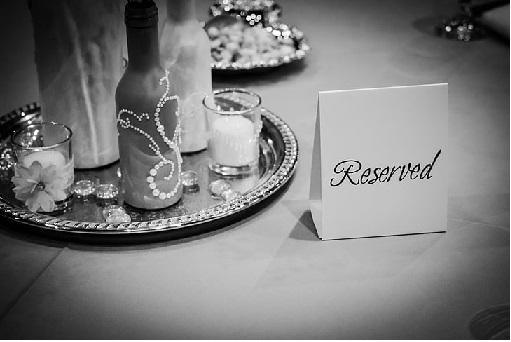
A boyfriend failing to obtain a restaurant reservation for an agreed upon date would be an example for the onset of an instance of Jealousy in Affect Engineering, before the emergence of any rival party at all.
Should another party enter the foray, such as a coworker inviting her out for a night of karaoke the next weekend, or a group of her friends inviting her to go out dancing, or even the release of the next book in a series that she was eagerly awaiting to read, the boyfriend may indeed view them as potential rivals for the girlfriend’s loyalty if they deliver on what they promise (e.g., a good time) while he could not. Loyalty in this case, might similarly be measured by the boyfriend as a reciprocation of effort, that is to say the girlfriend helping him achieve a goal he wants to do, such as spending time together watching the debut of a new movie he wants to see at the movie theater the following weekend. If she declines to go to see the movie in order to do one of the aforementioned three activities, then the fear that any of these rivals (karaoke, dancing, or a book) offers something that he cannot certainly becomes more amplified, but the fear that the loyalty had been lost was already present beforehand from a separate event, that is, the boyfriend forgetting to get the restaurant reservation.

Any of the three activities mentioned (Karaoke, dancing, or reading a book) can be viewed by the boyfriend as a rival for the girlfriend’s loyalty.
It is also certainly possible that the order of these events could be flipped; if the boyfriend had no previous faults beforehand and actually possessed the dinner reservation, but his girlfriend had declined to go to see the movie with him on the previous weekend prior to their scheduled dinner date for any of the above three alternatives, then the loyalty transaction would have not been upheld on her end in that instance. Affect Engineering would model that the girlfriend would be the Jealous party at that point, and the continuance of the loyalty transaction would be up to the boyfriend. It would be up to him to decide whether or not to continue the loyalty transaction thereafter.
Granted, most relationships are not this draconian and are somewhat more forgiving. The point here in the original scenario, however, is that the boyfriend’s fear that any of these potential rivals (karaoke with a coworker, dancing with friends, or reading a book) may have possibly supplanted him by taking his girlfriend’s loyalty, and the fear that he has lost his girlfriend’s loyalty by a failure on his own part (forgetting to make the restaurant reservation), stem from two separate sources since the vicariously felt emotions target two different parties:
1) The fear of him losing his girlfriend’s loyalty via a fault or shortcoming on his part has the beloved as the target of empathy.
2) The fear that a rival party has taken his girlfriend’s loyalty by offering something he could not has the rival as the target of empathy.
The self fearing that a rival will take or has already taken the beloved’s loyalty would more aptly be labeled an instance of Envy (i.e., contempt for the rival’s gain) in Affect Engineering’s framework, which will be addressed further below. The two emotions of Jealousy and Envy can and often do occur simultaneously in the same scenario in Affect Engineering, but they would be two separate emotions felt towards two different target parties in most cases: Jealousy felt with respect towards the beloved, and Envy felt with respect towards the rival.
The relationship also need not be a romantic one for Jealousy or Envy to take place. It may be a diplomatic one and related to military defense for instance. An alternative scenario will be considered where four countries only grow one type of fruit (Apples, Bananas, Cranberries, and Dragon Fruit) on their land. Land, notwithstanding, would be a highly prized commodity in this realm.
Two hypothetical countries, the Apple Nation and the Banana Republic, have an exclusive mutual defense pact with one another. If one is attacked by a belligerent country, then the other agrees to help defend it.
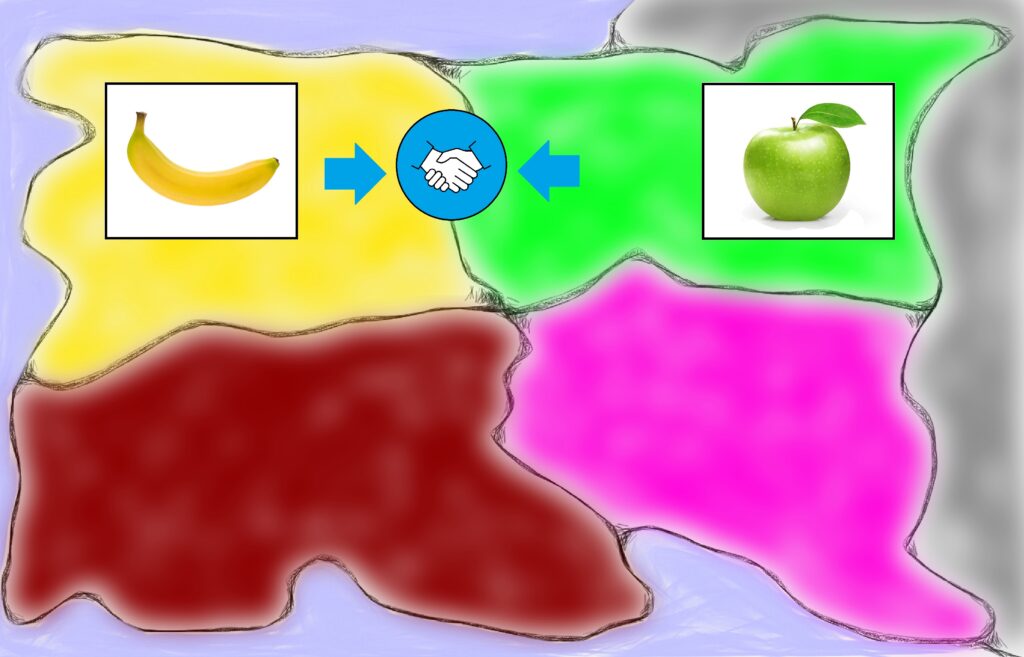
The Apple Nation and the Banana Republic have agreed to an exclusive mutual defense pact with one another, and agree to help defend one another should they be attacked.
However, should a hostile aggressor attack (e.g., the Cranberry Confederation), and the Apple Nation fails to help defend its ally, the Banana Republic, against them, then this would be considered an instance for the onset of Jealousy in Affect Engineering’s framework for the Apple Nation. Failure in this case would either constitute not sending enough help to thwart the Cranberry Confederation’s assault, or sending no help at all. The failure of the Apple Nation to successfully help the Banana Republic achieve its aim (i.e., maintaining territorial integrity) would jeopardize the loyalty held between the two, since the loyalty transaction was an exchange, because its benefits would likely only be seen as one way thereafter.
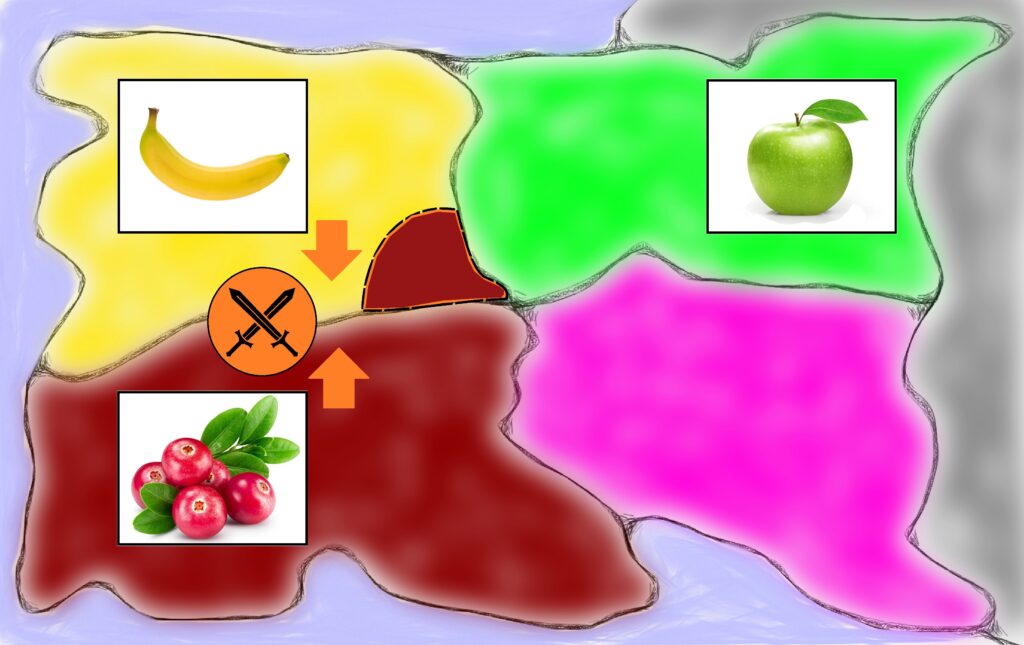
The Apple Nation failed to send enough help to ensure that the Banana Republic achieved its goal of maintaining territorial integrity, in this case, against the Cranberry Confederation.
Any other party that can offer the Banana Republic what the Apple Nation Apple failed to offer would be viewed as a potential rival to the Apple Nation for the Banana Republic’s loyalty. This would be the case, for instance, if the Dragon Fruit Dominion, acting on behalf of the Banana Republic’s interest, wages a military campaign against the Cranberry Confederation to restore the Banana Republic’s land.
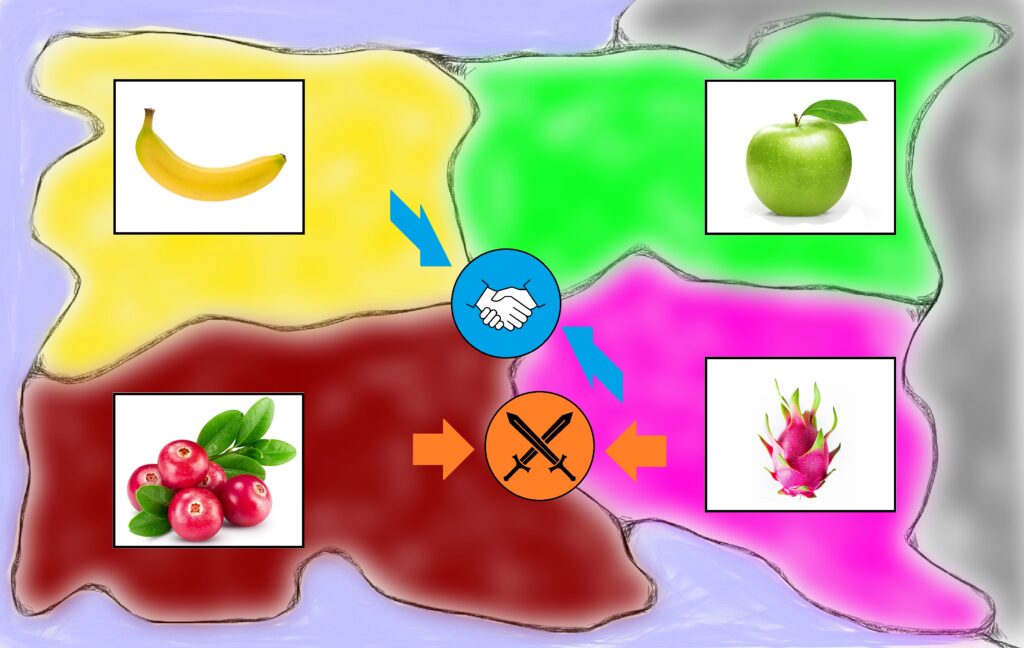
The Dragon Fruit Dominion, upon striking against the Cranberry Confederation to restore the Banana Republic’s territory, offers an exclusive mutual defense pact with them. The Dragon Fruit Dominion would then be viewed by the Apple Nation as a rival for the Banana Republic’s loyalty.
Affect Engineering would model that Jealousy would be felt by the Apple Nation with respect towards the Banana Republic for failing to help defend them against the Cranberry Confederation, and this would occur before the emergence of the Dragon Fruit Dominion as a rival. Affect Engineering would model that Envy (i.e., contempt for another party’s gain) would be felt by the Apple Nation with respect towards the Dragon Fruit Dominion for threatening to take away the Banana Republic’s loyalty; this might arise if the Apple Nation wanted to be the hero that came in and saved the day, but the Dragon Fruit Dominion usurped them instead.
To complete the example with the four Category Three Emotions, Affect Engineering would model Malevolence (i.e., successfully taking action to prevent another from achieving a goal) to be felt by the Cranberry Confederation towards the Banana Republic upon successfully seizing land held by the Banana Republic in the first place. Affect Engineering would model Benevolence (successfully taking action to enable an other to achieve a goal) to be felt by the Dragon Fruit Dominion towards the Banana Republic if they are able to successfully help the Banana Republic reclaim their land.
Jealousy, in Affect Engineering, is similar to Benevolence to the degree that the self wants the targeted other party to succeed and the self takes action to try to make this happen. However, the difference between the two lies in the fact that for the case of Jealousy, the self and the targeted other are not successful. In the case of Benevolence, however, the self and the targeted other party are both successful. The self’s lack of success to help the targeted other in the case of Jealousy is what jeopardizes the loyalty transaction, and opens the door for any rival party to then replace them thereafter. A state of initial amity and good will exists for both Benevolence and Jealousy in this framework.
Envy, on the other hand, has been described in this article and previous articles as contempt for another’s gain. As Benevolence is the counterpart to Malevolence in Affect Engineering’s framework, Envy is the counterpart to Jealousy in Affect Engineering. Envy can be also generally be thought of as the fear of condoning, or allowing to go unchecked, a rival party’s lack of loyalty, perfidiousness, or misdeeds that enabled them to acquire a gain that the self considers to be ill-gotten.
In this regard, Envy is also similar to Malevolence in affect Engineering’s framework. For both Envy and Malevolence, the self takes action to prevent a targeted other from achieving a purpose. However, in the case of Envy the self is unsuccessful in their endeavors to prevent a targeted other party from achieving a goal. In the case of Malevolence, the self is successful and the targeted other party fails to achieve their goal. An initial state of animosity and hostility exists for both Malevolence and Envy in this framework.
If the self merely wants or covets what the targeted other party manages to achieve or acquire, this is not sufficient to distinguish Envy in Affect Engineering. The core feature of Envy here is that the self does not want the targeted other party to achieve a goal and acquire a good of some sort, but the envied party succeeds anyway, despite the self’s efforts to prevent this from happening. The self does not have to want for themselves what the targeted other party acquired for the emotion to be classified as Envy here, they only have to want the other party not to have it. The self taking action to prevent the other party from acquiring a good, and failing to prevent them from acquiring it, is the necessary component. Moreover, even if the self does want what the targeted party acquired, which may oftentimes be the case, this would be modeled as a separate purpose, and a separate emotion would be modeled to be felt in Affect Engineering due to the framework’s adherence to its 1:1:1:1 Ratio.
Hence, the standard definitions of both jealousy and envy are streamlined in order to adhere to Affect Engineering’s 1:1:1:1 Ratio to avoid conflating two emotions into one for each. In Affect Engineering, Jealousy only concerns the fear of the self losing a beloved’s loyalty, and does not need it to be lost to a rival, but rather, just lost or at risk of being lost. Meanwhile, Envy in Affect Engineering only concerns a rival acquiring something the self does not want them to acquire, and the self does not need to want what the rival has for themselves. These aspects are not ignored completely, as both Jealousy and Envy are often modeled to occur simultaneously in the same situation in Affect Engineering, but would be felt towards different targeted other parties. The aspect of jealousy that is eliminated in Affect Engineering’s conception of Jealousy (i.e., the rival threatening to take the beloved’s loyalty), is usually covered by Envy in Affect Engineering. The aspect that of envy that is eliminated in Affect Engineering’s conception of Envy (i.e., the self wanting what the rival party has), is usually covered by Jealousy in Affect Engineering for instances where a beloved’s loyalty is at stake.
- The boyfriend fearing the loss of his girlfriend’s loyalty (e.g., loss of reciprocation in the above case) is an instance of Jealousy felt towards the girlfriend in Affect Engineering, and is irrespective of any rival. The boyfriend holding contempt for a rival party that threatens to take his girlfriend’s loyalty is an instance of Envy felt towards the rival party in Affect Engineering; the boyfriend does indeed want the girlfriend’s loyalty that the rival party appears to take, but this is a separate purpose and not included in Envy’s definition for Affect Engineering.
- The Apple Nation fearing the loss of the Banana Republic’s loyalty (e.g., the exclusive mutual defense pact) is an instance of Jealousy felt towards the Banana Republic in Affect Engineering and is irrespective of any rival party. The Apple Nation holding contempt for the Dragon Fruit Dominion for threatening to take the Banana Republic’s loyalty would be an instance of Envy in Affect Engineering; the Apple Nation does indeed want what the Dragon Fruit Dominion is on the verge of acquiring (the Banana Republic’s loyalty), but this is also a separate purpose and not included in Envy’s definition for Affect Engineering.
The four Category Three Emotions, or Compound Interactive Emotions, correspond to the Four Degrees of Empathy from the Category Two Emotions (See Article Eight: The Category II Emotions, or Four Degrees of Empathy, Question #2) and can be mapped on a similar two by two pundit square. The major exception is that the self possesses the ability to influence the outcome for the targeted other party, so there are some differences.
3) What are Indulgent Type and Protective Type Category Three Emotions and why is there a distinction between them in Affect Engineering?
SHORT ANSWER
Indulgent Type and Protective Type are two classifications for the four Category Three Emotions and they correspond to whether the pursuit of pleasure or avoidance of pain is being considered for the self. The distinction is used to acknowledge subtle differences between instances of the Compound Interactive Emotions that share similar objectives and characteristics. If Anxiety is at stake for the self, then a Category Three Emotion is classified as a Protective Type emotion, similar to the Avoidance of Pain Category One Emotions. If Negative Anxiety is at stake for the self, then a Category Three Emotion is classified as an Indulgent Type emotion, similar to the Pursuit of Pleasure Category One Emotions.
IN DEPTH EXPLANATION
All the Category Three Emotions involve the self actively attempting to influence the outcome for a targeted other party. They are nearly identical to the Category Two Emotions except for the fact that the self can influence the outcome for the targeted other party. This would be reflected in neurological models as well. For the Indulgent Type Category Three Emotions a Pursuit of Pleasure Emotion is felt by the self (e.g., Happiness, Guilt, or in other cases Courage or Euphoria). For the Protective Type Category Three Emotions an Avoidance of Pain Emotion is felt by the self (e.g., Sadness, Anger, or in other cases Grief, Fear, or potentially Disgust).
In the diagrams and sample neurological models below, the modifications of the variables in the exponents of functions (Threat and Efficacy components) that will maximize particular emotions felt will be stated. Although attentional processes, reasoning, and executive processes, could also modify them, they are not included in these models in order to minimize clutter. Article Four in this series, Emotional Responses and Emotional Regulation in Affect Engineering, goes into more detail with these concepts (Article 4 of 12).
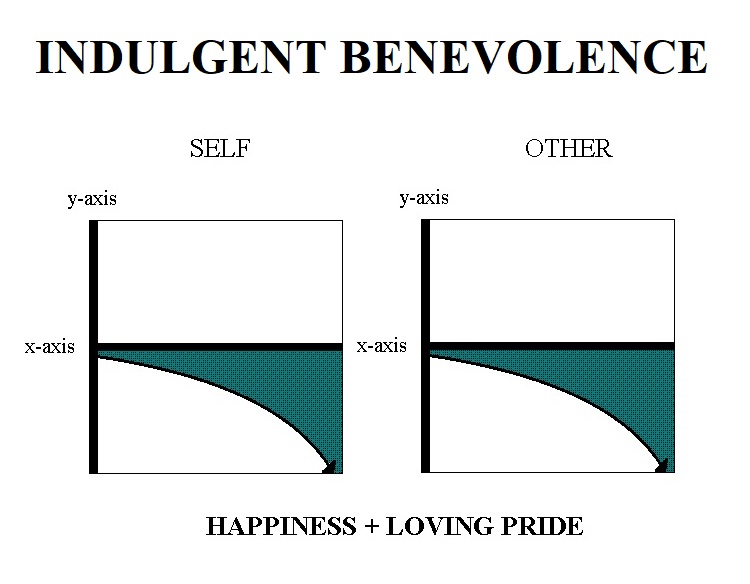
Indulgent Type Benevolence: Happiness + Loving Pride, or Courage + Loving Pride, or Euphoria + Loving Pride
Indulgent Type Benevolence entails the self wanting a targeted other party to succeed, and the self successfully achieves a purpose that ensures the targeted party succeeds as well. Moreover, further acquisition of an entity by the self will lead the self and targeted other away from equilibrium between the purpose and its complementary purpose (i.e., it is already available in ample supply).
This is the equivalent of the self spoiling the targeted party by performing an action that gives the targeted party an excess in some department. A parent or guardian giving a child an extra serving of food after they had already been adequately fed would be an example. A sample graph of Indulgent Benevolence (Happiness + Loving Pride) is below.
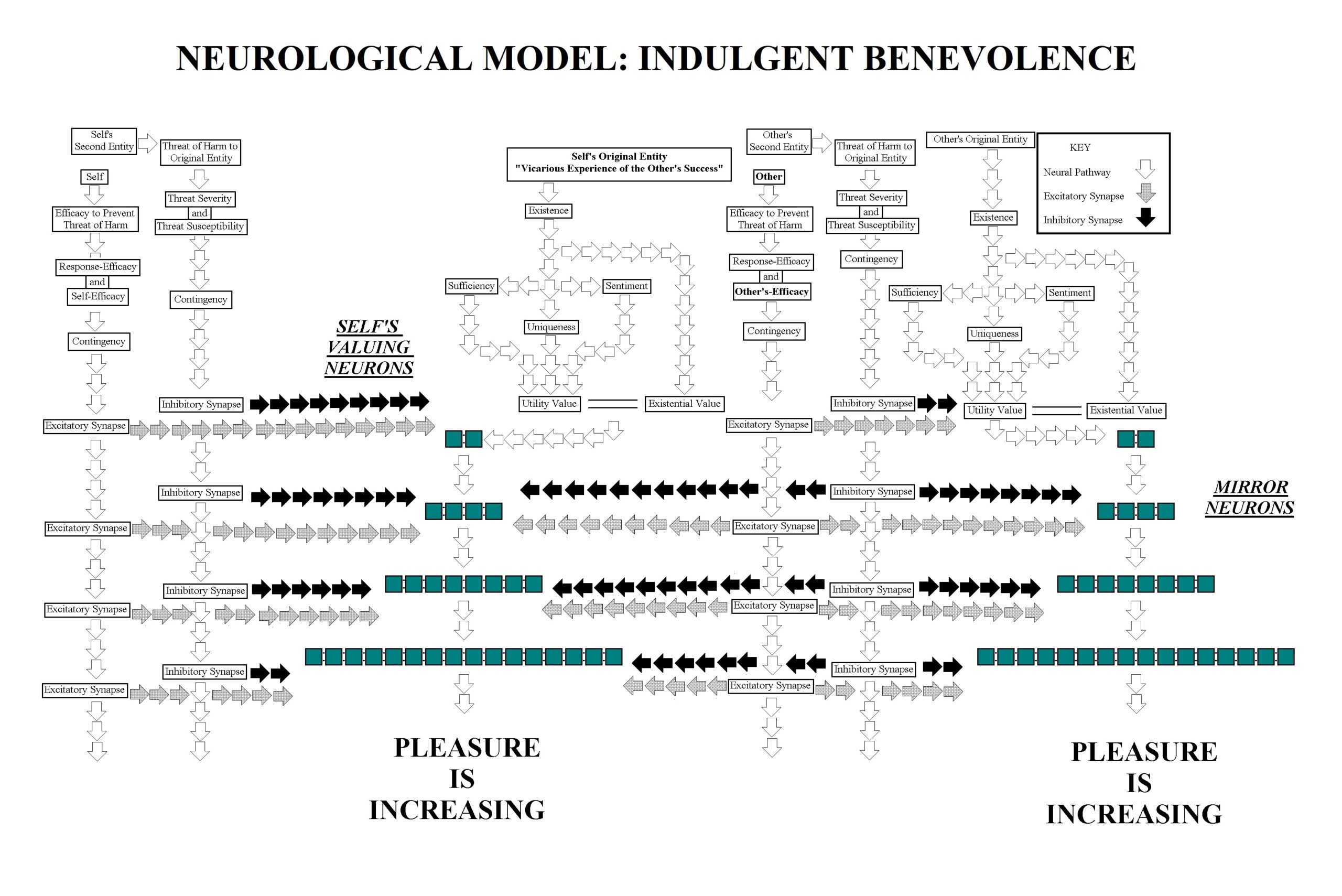
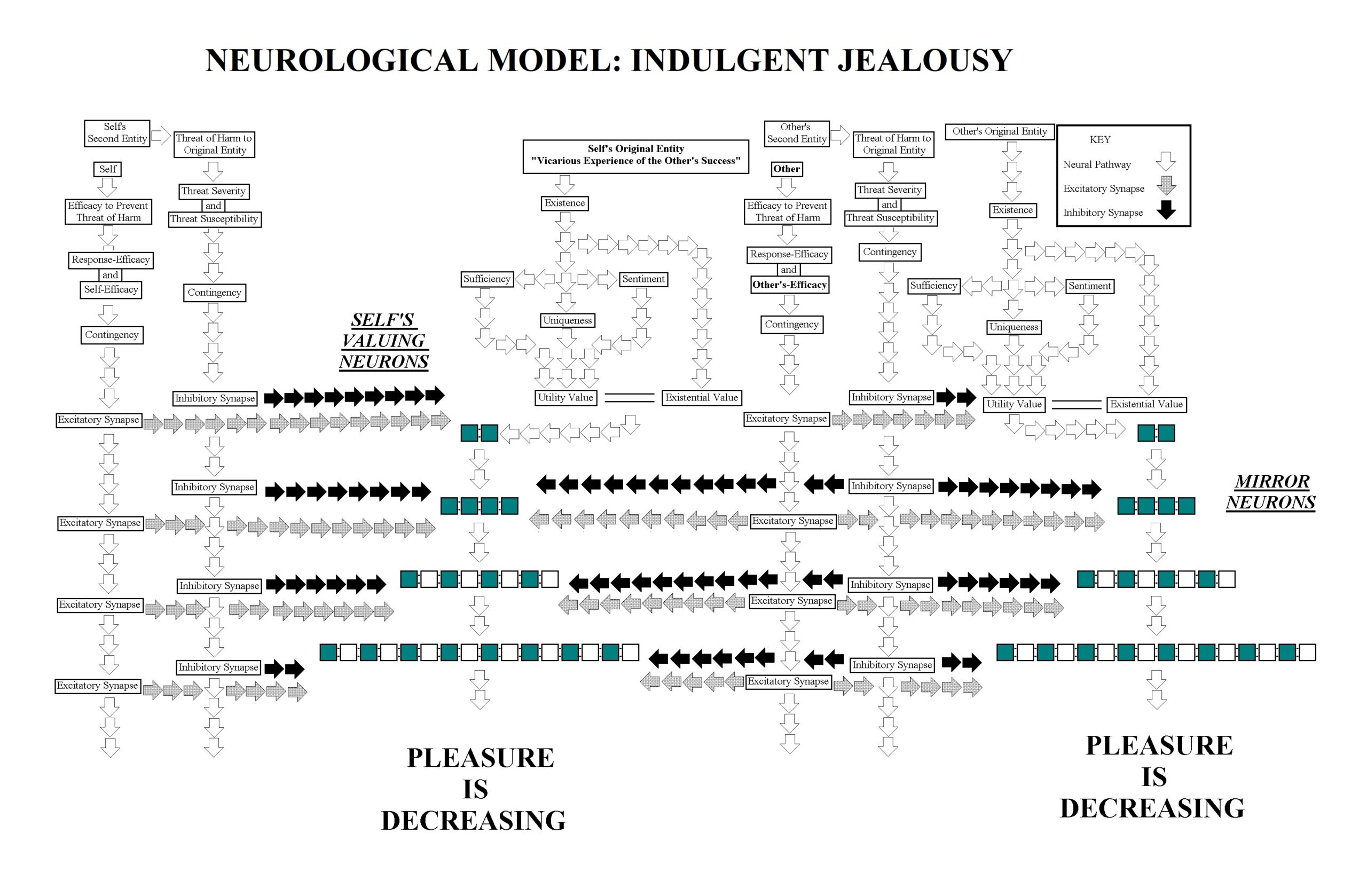
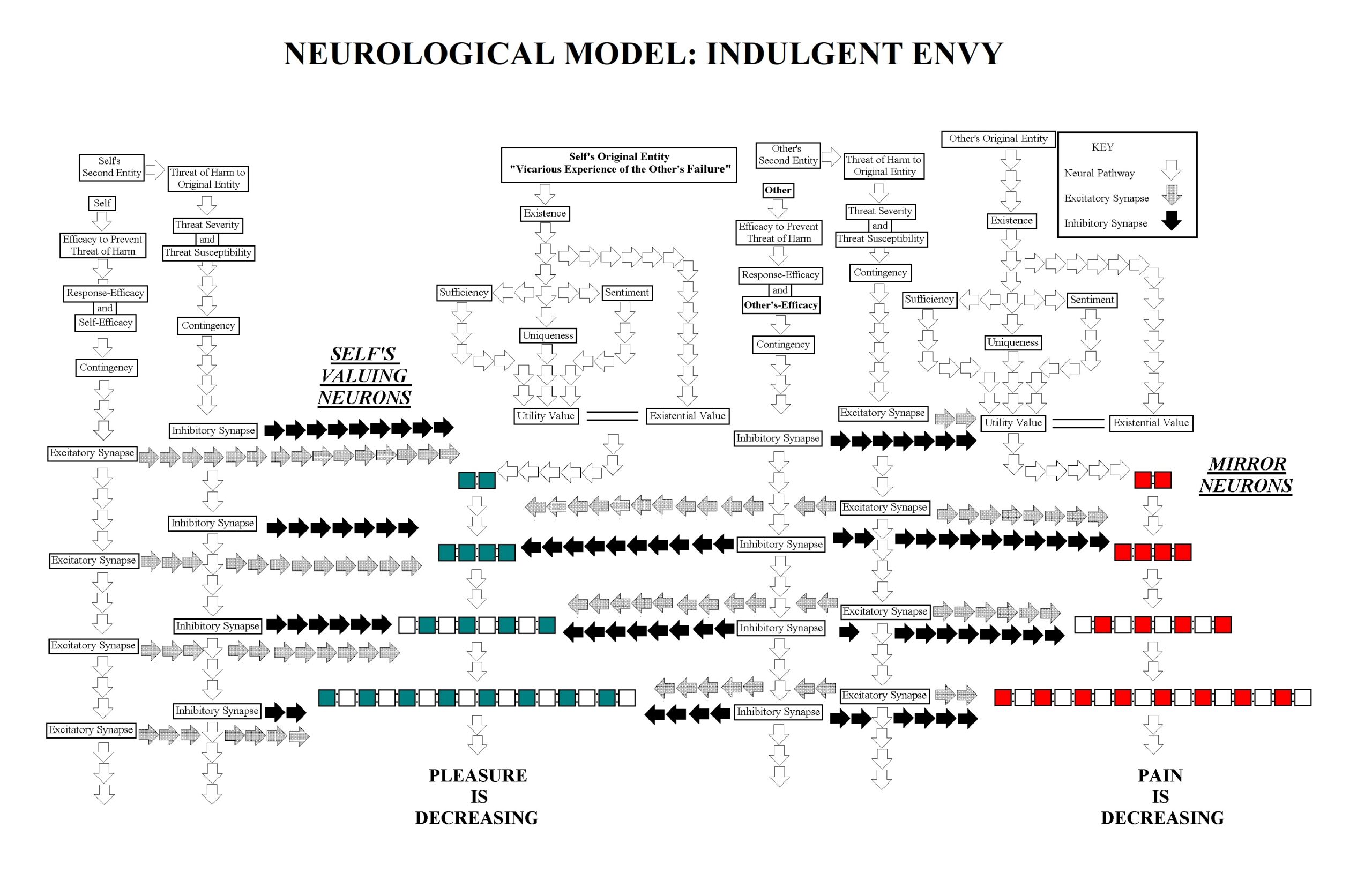
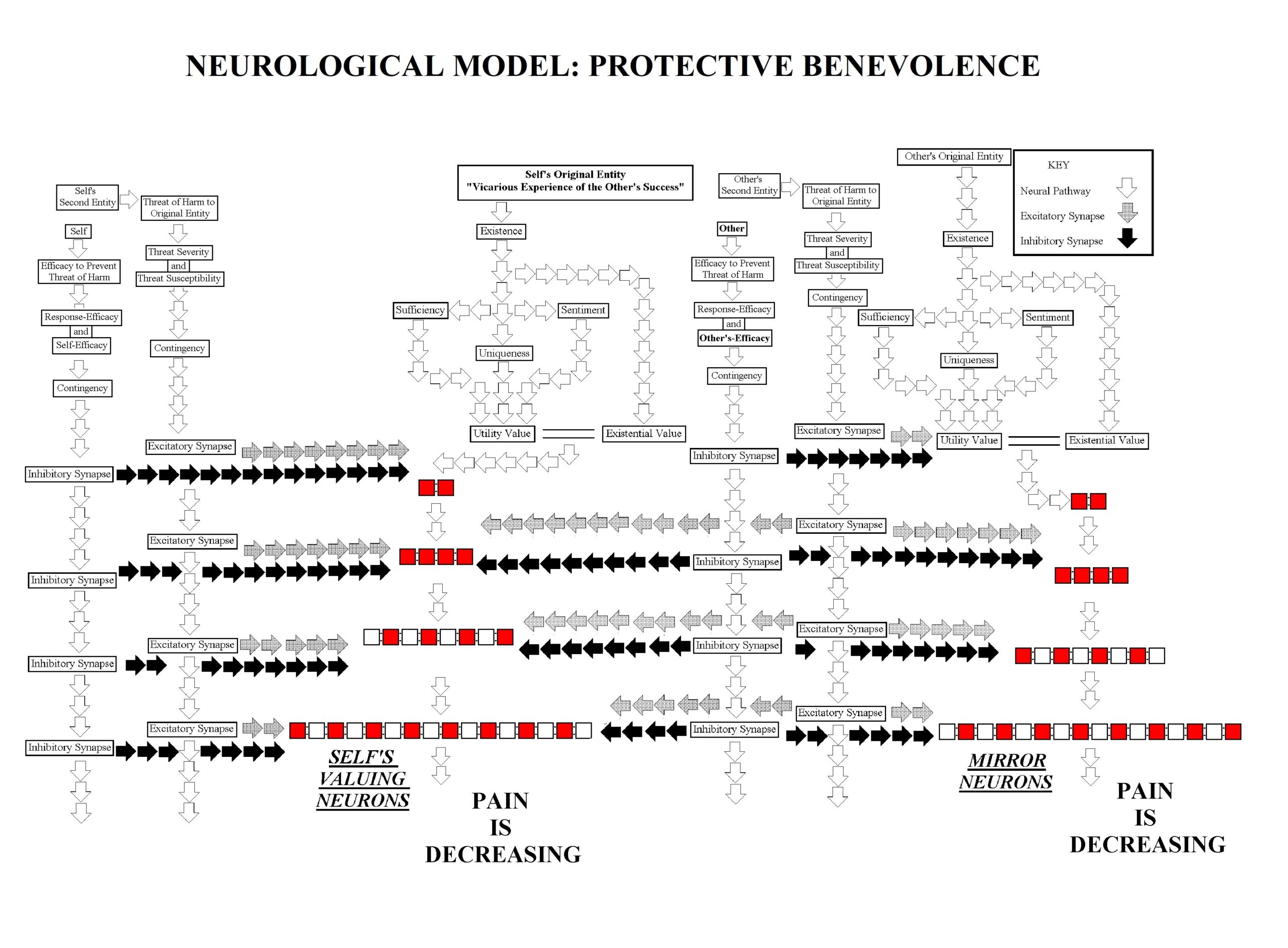
In the sample neurological model below, amplification of the Efficacy Components (variables of Response-Efficacy and Self-Efficacy) for both the Self and Other, along with a decrease in the Threat Components (variables of Threat-Severity and Threat Susceptibility) will maximize Indulgent Benevolence. This could happen if the parent or guardian were able to easily acquire the additional food item for their child, despite the fact the child was already well fed, provided for, and the child successfully eats it.
Indulgent Type Jealousy: Guilt + Sympathetic Shame
Indulgent Type Jealousy entails the self wanting a targeted other party to succeed, but the self is unsuccessful at fulfilling a purpose that would ensure the targeted party succeeds; both the self and the other party fail. Moreover, as further acquisition of an entity by the self would have lead the self and targeted other party away from equilibrium between the purpose and its complementary purpose (it is already available in ample supply), this results in a reduction of Negative Anxiety (e.g., pleasure) felt with respect towards the purpose at hand.
This would be the equivalent of the self attempting to spoil the targeted party by performing an action that would give the targeted party an excess, but is unsuccessful. Using the same example as above, if a parent or guardian attempted to give their child an extra serving of food at a restaurant, such as a dessert, but to their dismay discovered they are not able to access it any longer because the restaurant is closing and they were too late, then Indulgent Jealousy would be modeled here. A sample graph of Indulgent Jealousy (Guilt + Sympathetic Shame) is below.
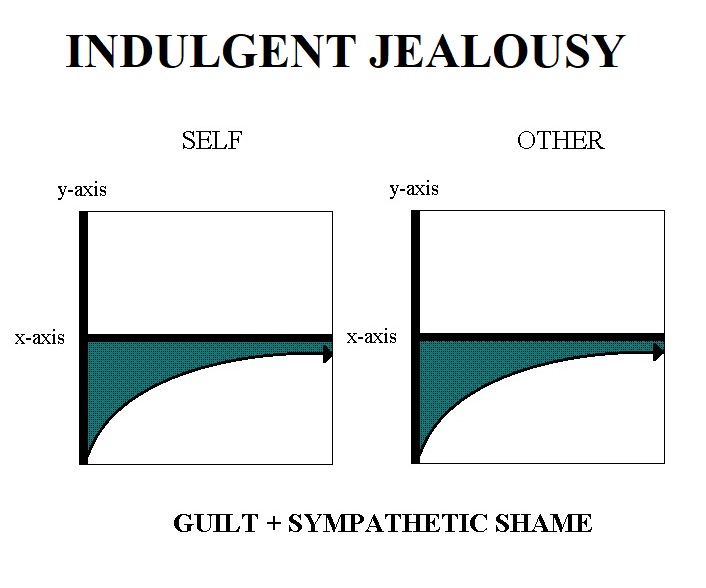
In the sample neurological model below, a decrease of the Efficacy Components (variables of Response-Efficacy and Self-Efficacy) for both the self and other party, along with an amplification in the Threat Components (variables of Threat-Severity and Threat Susceptibility) will maximize Indulgent Jealousy felt. This could happen if the parent or guardian were suddenly not able to easily acquire the additional food for their child to eat due to the restaurant closing earlier than anticipated. Because the child was already adequately fed beforehand, however, Affect Engineering only models a reduction in Negative Anxiety invested (e.g., pleasure) with respect to the particular goal.
Indulgent Type Malevolence: Happiness + Hateful Humiliation, or Courage + Hateful Humiliation, or Euphoria + Hateful Humiliation
Indulgent Type Malevolence entails the self wanting a targeted other party to fail, and the self is successful at fulfilling a purpose that would ensure the targeted party fails; the self succeeds and the other party fails. Moreover, as further acquisition of an entity by the self leads the self and the targeted other away from equilibrium between the purpose and its complementary purpose (it is already available in ample supply for the self, and not in ample supply for the other party), this results in an increase of Negative Anxiety (e.g., pleasure) felt by the self with respect towards the purpose at hand, but an increase in Positive Anxiety (e.g., pain) felt by the other.
This would be the equivalent of the self attempting to punish the targeted party far beyond equilibrium up to the point that it would closely resemble torture. If, for example, a gardener were attempting to eliminate weeds from a plot of soil, and successfully withheld water from the garden until the weeds began to wither from dehydration, then Indulgent Malevolence would be modeled here. A sample graph of Indulgent Malevolence (Happiness + Hateful Humiliation) is below.
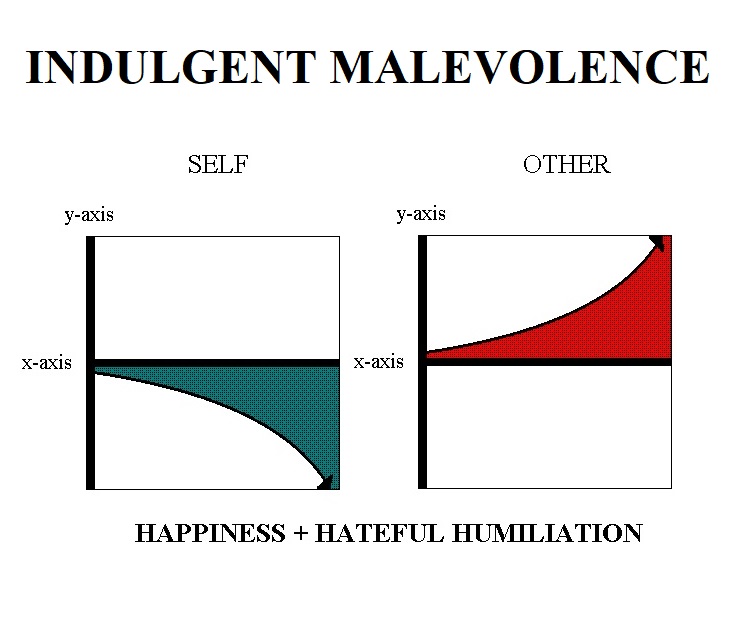
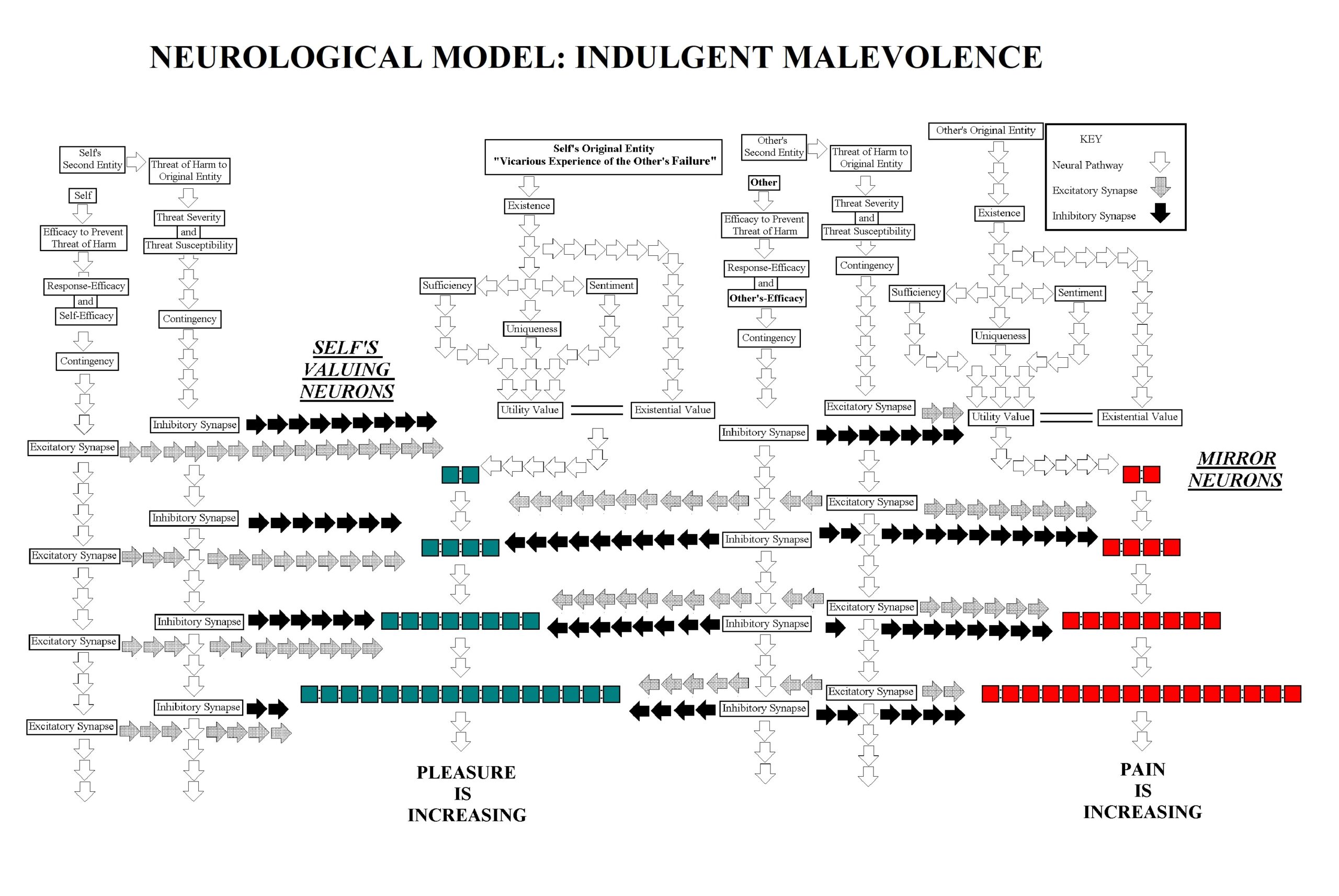
In the sample neurological model below, an increase of the Efficacy Components (variables of Response-Efficacy and Self-Efficacy) for the self and a decrease of the Threat Components (variables of Threat-Severity and Threat Susceptibility) for the self, will maximize Indulgent Malevolence felt. For the targeted other party, Efficacy Components would need to decrease and Threat Components would need to increase in order to maximize Indulgent Malevolence felt by the self. This could happen if the gardener is easily able to withhold water from the plot of soil with no threats of rain, and if the weeds in the garden are unable to reach deep enough in the ground to pull underground water from the soil. If the weeds were already on the verge of wilting from dehydration, then this will push them closer to perishing.
Indulgent Type Envy: Guilt + Antipathetic Mercy
Indulgent Type Envy entails the self wanting a targeted other party to fail, but the self is unsuccessful at fulfilling a purpose that would ensure the targeted party fails; the self fails but the other party succeeds. Moreover, as further acquisition of an entity by the self would have lead the self and the targeted other away from equilibrium between the purpose and its complementary purpose (i.e., it is already available in ample supply for the self, but not for the other party), the failure by the self results in a decrease of Negative Anxiety (e.g., pleasure) felt by the self with respect towards the purpose at hand, and a decrease in Positive Anxiety (e.g., pain) felt by the other.
This would be the equivalent of the self attempting to punish the targeted party far beyond equilibrium, but because they fail in the effort the targeted party recovers towards equilibrium. If, for example, the same gardener were attempting to eliminate weeds from a plot of soil by withholding water from the garden until they began to wither from dehydration, but failed to do so because it rained heavily, then Indulgent Envy would be modeled here. A sample graph of Indulgent Envy (Guilt + Antipathetic Mercy) is below.
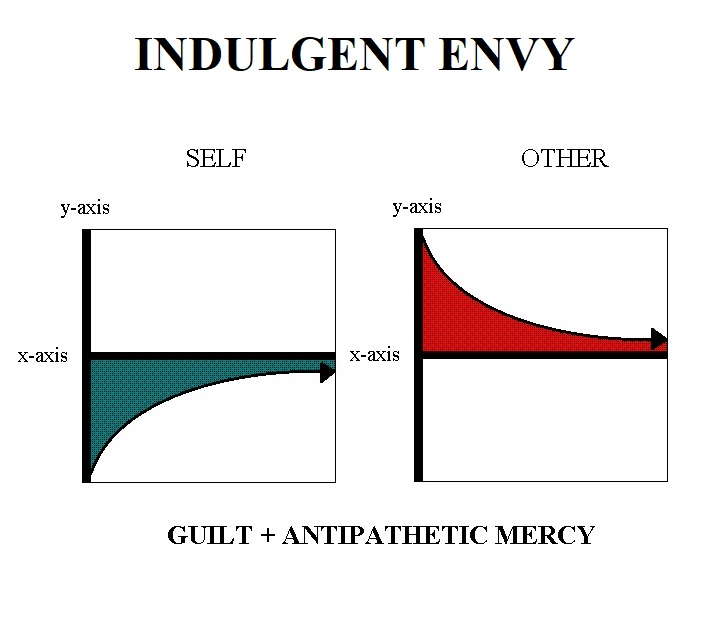
In the sample neurological model below, a decrease of the Efficacy Components (variables of Response-Efficacy and Self-Efficacy) for the self and an increase of the Threat Components (variables of Threat-Severity and Threat Susceptibility) for the self, will maximize Indulgent Envy felt. For the targeted other party, Efficacy Components would need to increase and Threat Components would need to decrease in order to maximize Indulgent Envy felt by the self. This could happen if the gardener attempts to withhold water from the plot of soil to dry out the weeds, but a heavy rainstorm sweeps past enabling the weeds in the garden to hydrate or reach deep enough into the soil to pull up moisture from an elevated water table. If the weeds were already on the verge of wilting from dehydration, then this will bring them closer to equilibrium and away from dying.
Protective Type Benevolence: Anger + Loving Pride, or Disgust + Loving Pride
Protective Type Benevolence entails the self wanting a targeted other party to succeed, and the self successfully achieving a purpose that ensures the targeted party succeeds as well. Moreover, further acquisition of an entity by the self will lead the self and targeted other towards equilibrium between the purpose and its complementary purpose (i.e., it is not available in ample supply for the self or other party).
This might be the equivalent of the self wanting to better provide for the targeted party by performing an action that gives the targeted party resources to help restore its well being. A parent or guardian giving a starving child a serving of food after they had been malnourished for an extended period of time would be an example. A sample graph of Protective Benevolence (Anger + Loving Pride) is below.
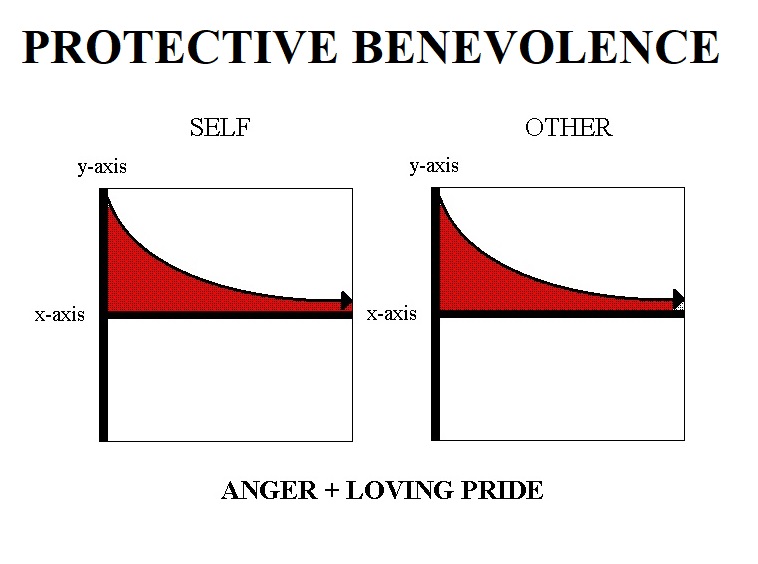
In the sample neurological model below, amplification of the Efficacy Components (variables of Response-Efficacy and Self-Efficacy) for both the Self and Other, along with a decrease in the Threat Components (variables of Threat-Severity and Threat Susceptibility) will maximize Protective Benevolence. This could happen if the parent or guardian were able to successfully acquire food to give to their child to eat if, up until that point, the child had been starving and extremely malnourished.
Protective Type Jealousy: Sadness + Sympathetic Shame, or Fear + Sympathetic Shame, or Grief + Sympathetic Shame
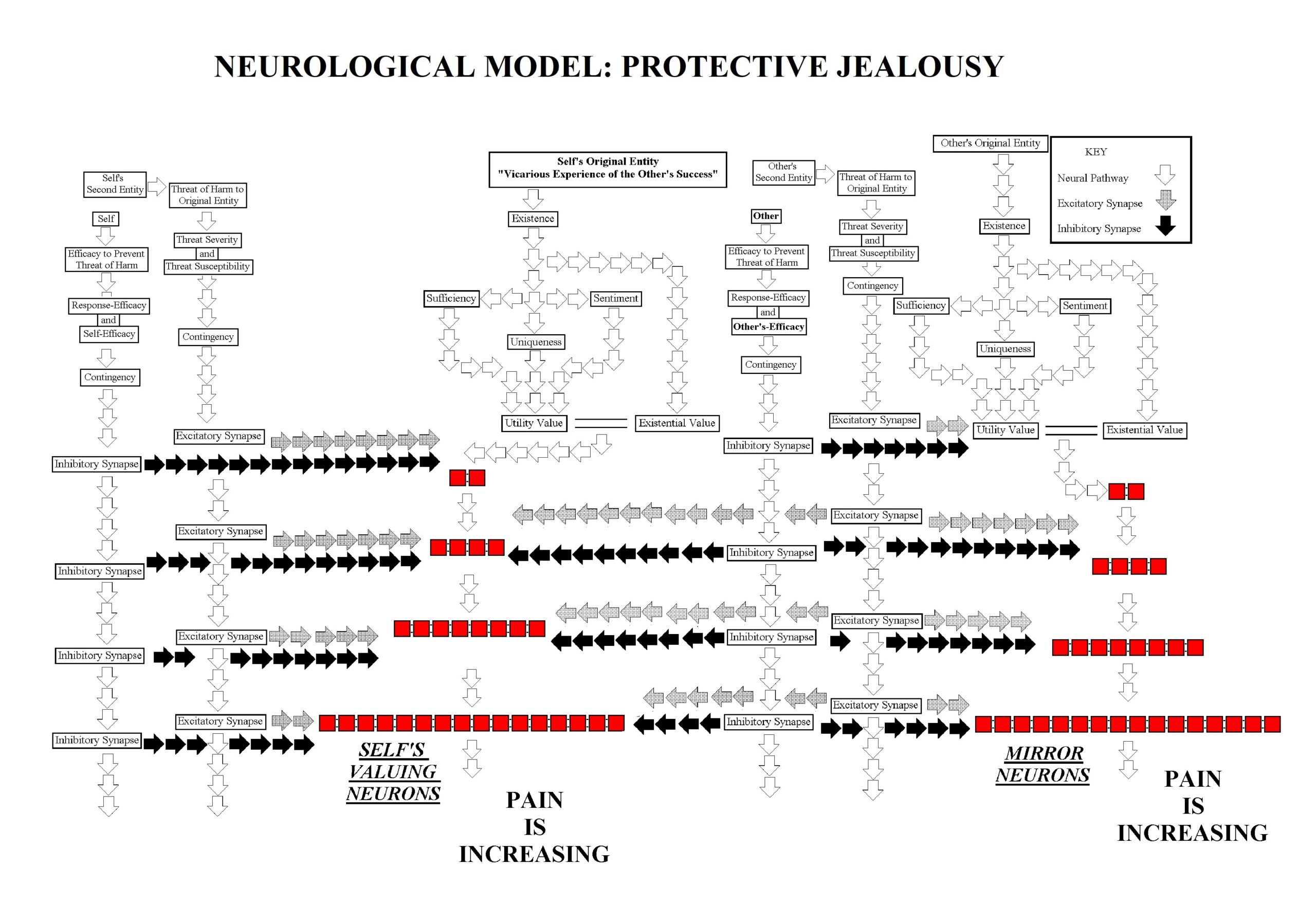
Protective Type Jealousy entails the self wanting a targeted other party to succeed, but the self is unsuccessful at fulfilling a purpose that would ensure the targeted party succeeds; both the self and the other party fail. Moreover, as further acquisition of an entity by the self would have lead the self and targeted other towards equilibrium between the purpose and its complementary purpose (i.e., it is not available in ample supply for the self or the other party), this results in an increase in Positive Anxiety (e.g., pain) felt with respect towards the purpose at hand.
This would be the equivalent of the self attempting to provide resources for the targeted party by performing an action that would bring the targeted party closer to equilibrium, but the self is unsuccessful. Using the same example as above, if a parent or guardian attempted to give their starving child a serving of food, but to their dismay discovered they are not able to access it any longer for any reason, then Protective Jealousy would be modeled here. A sample graph of Indulgent Jealousy (Sadness + Sympathetic Shame) is below.
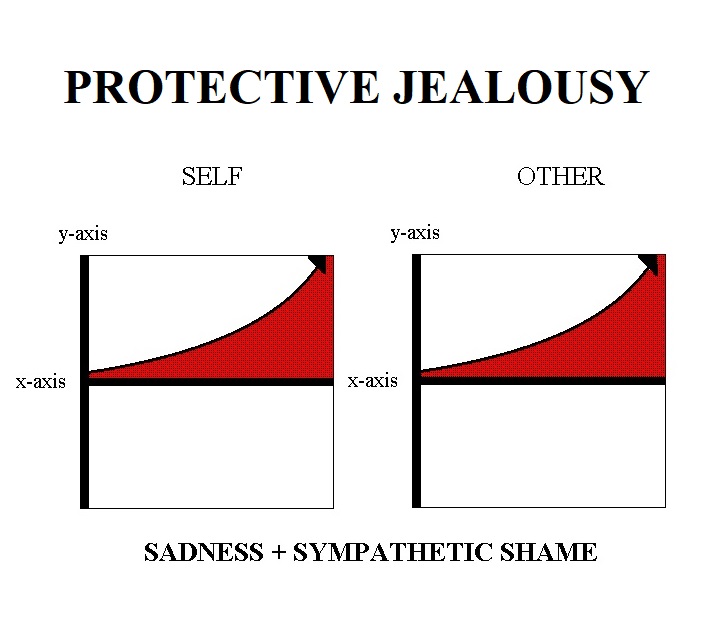
In the sample neurological model below, a decrease of the Efficacy Components (variables of Response-Efficacy and Self-Efficacy) for both the self and other party, along with an amplification in the Threat Components (variables of Threat-Severity and Threat Susceptibility) will maximize Protective Jealousy felt. This could happen if the parent or guardian were suddenly not able to acquire the food item to provide for their starving child to eat. Because the child was already malnourished beforehand, Affect Engineering would model an increase Positive Anxiety invested (e.g., pain) with respect to the particular goal.
Protective Type Malevolence: Anger + Hateful Humiliation, or Disgust + Hateful Humiliation
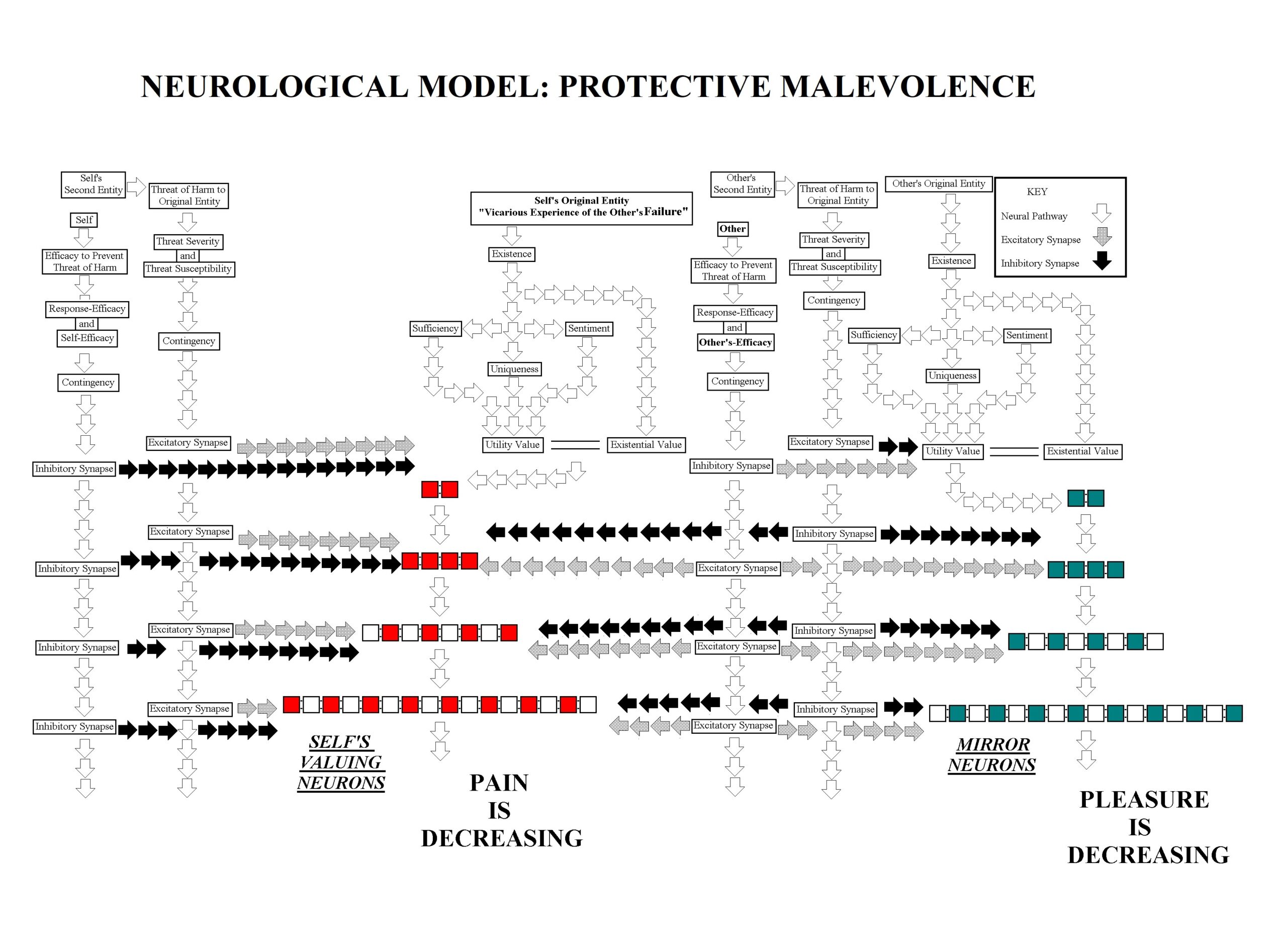
Protective Type Malevolence entails the self wanting a targeted other party to fail, and the self is successful at fulfilling a purpose that would ensure the targeted party fails; the self succeeds but the other fails. Moreover, as further acquisition of an entity by the self leads the self and the targeted other towards a restoration of equilibrium between the purpose and its complementary purpose (i.e., the entity is not in ample supply for the self), this results in a decrease of Positive Anxiety (e.g., pain) felt by the self with respect towards the purpose at hand, and a decrease in Positive Anxiety (e.g., pleasure) felt by the targeted other.
This would be the equivalent of the self attempting to restrict a targeted party that is enjoying success far beyond equilibrium. If, for example, a gardener were attempting to eliminate weeds that had completely overrun a plot of soil, and the gardener successfully withheld water from the garden until the weeds began to wither from dehydration, culling their numbers, then Protective Malevolence would be modeled here. A sample graph of Indulgent Malevolence (Anger + Hateful Humiliation) is below.
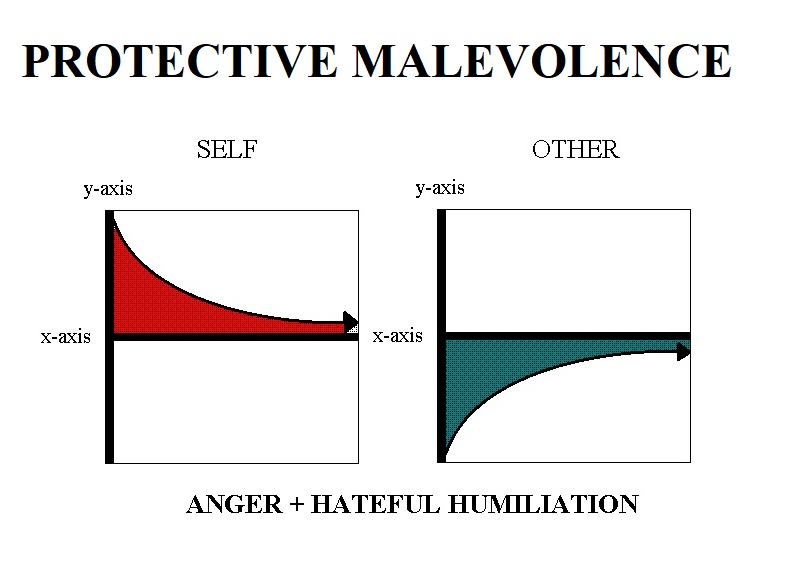
In the sample neurological model below, an increase of the Efficacy Components (variables of Response-Efficacy and Self-Efficacy) for the self and a decrease of the Threat Components (variables of Threat-Severity and Threat Susceptibility) for the self, will maximize Protective Malevolence felt. For the targeted other party, Efficacy Components would need to decrease and Threat Components would need to increase in order to maximize Protective Malevolence felt by the self. This could happen if the gardener is able to withhold water from the plot of soil with no threats of rain, and if the weeds in the garden are unable to reach deep enough in the ground to pull underground water from the soil. Because the weeds were thriving prior to this, the self’s success here only brings them closer to equilibrium.
Protective Type Envy: Sadness + Antipathetic Mercy, or Fear + Antipathetic Mercy, or Grief + Antipathetic Mercy
Protective Type Envy entails the self wanting a targeted other party to fail, but the self is unsuccessful at fulfilling a purpose that would ensure the targeted party fails; the self fails but the other party succeeds. Moreover, as further acquisition of an entity by the self would have lead the self and the targeted other towards a restoration of equilibrium between the purpose and its complementary purpose (i.e., it is not available in ample supply for the self and at a deficiency), the failure by the self results in an increase of Positive Anxiety (e.g., pain) felt by the self with respect towards the purpose at hand, and an increase in Negative Anxiety (e.g., pleasure) felt by the other.
This would be the equivalent of the self attempting to restrict the targeted party and bring it closer to equilibrium, but because they fail in their efforts the targeted party continues thriving far beyond equilibrium. If, for example, the same gardener were attempting to eliminate weeds that had completely overrun a plot of soil by withholding water from the garden until the weeds began to wither from dehydration, but fails to do so (e.g., it rains heavily) then Protective Envy would be modeled here. A sample graph of Protective Envy (Sadness+ Antipathetic Mercy) is shown below.
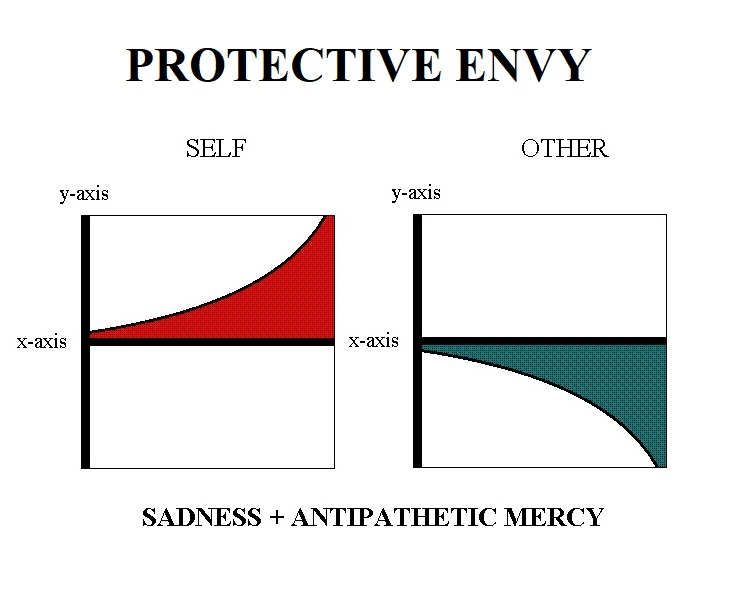
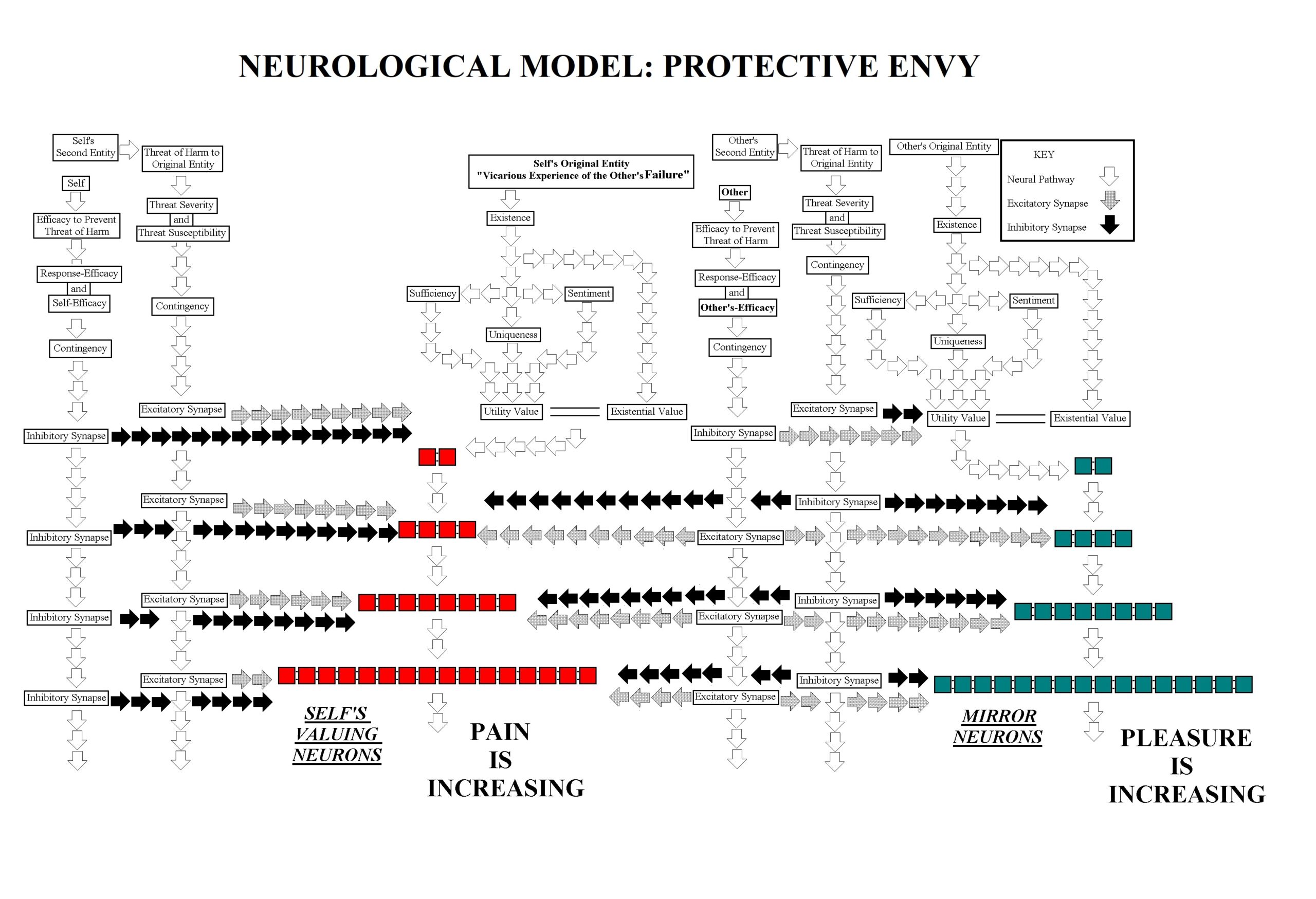
In the sample neurological model below, a decrease of the Efficacy Components (variables of Response-Efficacy and Self-Efficacy) for the self and a increase of the Threat Components (variables of Threat-Severity and Threat Susceptibility) for the self, will maximize Protective Envy felt. For the targeted other party, Efficacy Components would need to increase and Threat Components would need to decrease in order to maximize Protective Envy felt by the self. This could happen if the gardener attempts to withhold water from the plot of soil to dry out the weeds, but a heavy rainstorm sweeps past enabling the already thriving weeds in the garden to hydrate and further solidify their hold on the soil to the point they become wildly successful.
4) What makes Category Three Emotions valuable to an individual?
SHORT ANSWER
Category Three Emotions signal messages towards the self, the target of empathy (i.e., the other party) and towards third parties or outsiders observing the scenario. Much of the value or usefulness that Category Three emotions provide to an individual also comes from these messages that they deliver to observers by setting the stage for establishing new relationships and offering suggestions for courses of action.
IN DEPTH EXPLANATION
The Category Three Emotions serve a handful of aims for both the individual, the targeted other party or target of empathy, and third party observers.
Self
In regards to the self, the Category Three Emotions, like the other Categories of Emotions, are posited to serve as a call to action to the self in some manner and they also provide feedback to the self in Affect Engineering.
The presence of either Benevolence or Jealousy indicate that the self generally holds the target of empathy in good will and amity. For Benevolence, the self successfully helps the targeted other achieve a goal and this emotion would call the self to continue doing what they are doing in order to maintain that. The presence of Jealousy, in comparison, indicates that the self would need to do more to help the targeted other achieve a goal, and that some some of change for the self is needed.
In contrast, Malevolence and Envy indicate that the self generally holds the target of empathy in a state of hostility and enmity. For Malevolence, the self successfully prevents the targeted other from achieving a goal and this emotion would call the self to continue doing what they are doing in order to maintain that. The presence of Envy, however, indicates that the self would need to do more to help prevent the targeted other from achieving a goal, and that some of change for the self is needed.
Target of Empathy (The Other Party)
Similarly, these four emotion also send a message to the target of empathy, or the targeted other party.
In the case of Benevolence, the self’s efforts to help the targeted other party achieve a goal can encourage the targeted party to collaborate with the self and even reciprocate the Benevolence. For Jealousy, depending upon the extent to which the self exhibits a fear of losing the targeted other party’s loyalty, it may encourage the other party to forgive the self’s shortcoming, for instance, on the condition that circumstances improve.
In contrast to this, Malevolence and Envy, which both signal hostility and enmity, the message to the target of empathy would be more confrontational. In the case of Malevolence, the self successfully taking action to prevent the targeted other from achieving a goal is straightforwardly antagonistic and territorial in nature. For Envy, even though the self is unsuccessful at preventing a targeted other from achieving a goal, there is still a territorial nature to this emotion implying that the targeted other should not tempt their luck again and should be wary with future endeavors.
Third Party Observers
Finally, to third party observers witnessing instances of these emotions, the Category Three Emotions also signal alliances, rivalries, and suggestions for what courses of action would be considered safe or optimal:
- Benevolence: A third party witnessing the self demonstrate Benevolence towards a targeted other party would realize that a state of good will and amity exists between the two and that aggression towards one would likely provoke the other. Acts of kindness, however, would likely be looked upon favorable, for instance, if the self considers the friend of a friend a friend.
- Jealousy: A third party witnessing the self demonstrate Jealousy towards a targeted other party would know that a state of good will once existed, that it may still exist, or that it may be more fluid and uncertain if the self is attempting to reconcile and repair the relationship. Similar to Benevolence, any act of aggression by a third party towards the targeted party (the object of Jealousy), may provoke the self to act as a means of reconciliation. Acts of kindness, however, may alternatively be looked upon either favorably or unfavorably depending on whether or not the self views the third party as a potential threat.
- Malevolence: A third party witnessing the self demonstrate Malevolence towards a targeted other party would know that a state of hostility exists between the two, and that any act of kindness towards the other party would likely be met with hostility from the self for appearing to side with their rival. Acts of aggression towards the rival, however, would likely be met with approval, especially if the self considers the enemy of an enemy to be a friend.
- Envy: A third party witnessing the self demonstrate Envy towards a targeted other party would also know that a state of hostility once existed between the self and the other, that it may still exist, and that the self may be contemplating retribution of some sort against the rival in the future. Similar to Malevolence, any act of kindness towards the other party might be met with hostility from the self for appearing to side with their rival. Acts of aggression by a third party would likely be met with approval, unless the self the dynamic has changed. Envy, like Jealousy, also suggests a fluid dynamic between the self and the other party, so uncertainty may exist.
Preview
The next article, number ten, will go into more detail on the final class of emotions in Affect Engineering, Category Four Emotions: The Emotive States.
Next Article On the Nature of Emotions: Category IV Emotions, the Emotive States (Article 10 of 12)