


In this first post after the twelve article series in regards to Affect Engineering, On the Nature of Emotions, some aspects from the series will be kept the same. This includes listing what the post will be about at the beginning along with any questions that it aims to address as I liked the structure it gave to my posts. However, there will be no short answer section in order to minimize redundancy.
Topics In This Post
There will a pair of book endorsements for two books that I have recently read and enjoyed. They are both by the same author, Lisa Feldman Barrett. I was fortunate enough to obtain them both as part of a package deal.
- How Emotions are Made: The Secret Life of the Brain (2017)
- Seven and a Half Lessons About the Brain (2020)
It will also include my answers to the following questions:
- What do you think the psychology of emotion currently needs the most as an academic field?
- How does Affect Engineering compare or relate to other theories of emotion?
1) Book Endorsements
Clearly I was late to the party in deciding to read these books, as How Emotions Are Made: The Secret Life of the Brain has been out in the world for almost a decade, and Seven and a Half Lessons About the Brain for six years now, but better late than never as many people say. As for how I discovered her, somewhere online I recall reading that Lisa Feldman Barrett is in the top 1% of most cited neuroscientists in the world, and made the decision to investigate some of her published literature.
How Emotions are Made: The Secret Life of the Brain (2017)
and
Seven and a Half Lessons About the Brain (2020)
What I enjoyed about both books
I enjoyed the conversational nature of the writing most perhaps, along with the abundance and elegance of metaphors chosen to explain what otherwise might seem to be dense concepts to most. Barrett’s description of a “Body Budget” to explain allostasis, and her description of emotions as predictions were compelling and eloquent in my opinion. I could also easily see how many of her ideas would fit within my own framework for understanding emotions, though this did not surprise me much for reasons I will explain later in this article.
The boldness of Barrett’s language at times was also refreshing and sometimes funny, but it was tempered with enough modesty to not border on arrogance in my opinion. Even if one holds a viewpoint opposed to her own model, the Theory of Constructed Emotion, the ideas presented in the book are worth exploring in my judgment, and most people will learn something new upon reading it. For the casual reader, Seven and a Half Lessons About the Brain (2020) would perhaps be the more user-friendly book for anyone looking to broaden their understanding of emotions, but How Emotions are Made (2017) is fairly accessible as well, despite bing the longer of the two. How Emotions are Made did seem to spend more of its time critiquing Basic Emotion Theory; proponents of Basic Emotion Theory, or of Behaviorism among other related theories, might take some offense to the directness of her language with regards to that, but this did not bother me.
Where Does Affect Engineering Reside in the Debate Between Barrett’s Theory of Constructed Emotion and Paul Ekman’s Basic Emotion Theory?
One of my primary aims in designing Affect Engineering’s was to explain emotions in a way that made sense to me to clarify my own conception of the topic. If it can also facilitate discourse between different schools of thought using a common language, math in this case, then I would consider that a bonus. I have generally viewed Affect Engineering as a standardization tool. Taking sides in debates between different theories of emotion or proving one model over the other was not my intent in creating it originally. Creating a framework that could accurately represent the ideas in not just both of these theories of emotion, but also other completely different theories of emotion from other approaches (e.g., more physiological approaches, and cognitive appraisal based ones), was one of my more secondary and lofty objectives when I began organizing Affect Engineering into a framework. This was a task made more difficult by the fact that many theories of emotion are fundamentally incompatible with one another due to them operating under assumptions that conflict with one another, due to using different definitions for terms, or due to emphasizing different criteria concerning emotions and the formation of them.
Affect Engineering, fortunately, is a flexible framework. If the principles from a more constructivist approach, such as Barret’s Theory of Constructed Emotion are held at the fore by someone using Affect Engineering’s framework, then each individual might be assumed to essentially build their own functions along with the variables and the relationships between. This construction of a function would be based off of and shaped by their life experiences and learning from their environment, and inevitably there would be more variety in their design as a reslt.
Alternatively, if the principles from a more evolutionary approach, such as Basic Emotion Theory or other discrete emotion theories are held at the fore in Affect Engineering, then genes and natural selection would be held to play a larger role in the formation of the functions used in Affect Engineering. The functions in Affect Engineering, would more or less be modeled to be universal in this case, similar in structure, and arising more through nature (e.g., heredity) than nurture and the environment.
As I stated before, my main objective with Affect Engineering was never with taking sides in these debates, but rather in designing a framework that made sense to me. If debates between these different approaches can be resolved, or it they at least become better at relating with or contrasting to one another as a result of the ideas in Affect Engineering, then I would consider that to be a success.
2) What do you think the psychology of emotion currently needs most as an academic field?
It is not a secret that the psychology of emotion, or affective science, relative to other academic fields, suffers from fragmentation and is generally regarded as a messy or disorganized academic field due to competing theories and definitions, as well as the complexity of the subject matter. Whether or not this is its most pressing issue is perhaps debatable, but the general lack of consensus on what an emotion is, how emotions should be defined, classified, and measured, has made attempts to unify, or to at least organize the discipline, difficult. Creating a foundation for knowledge is difficult when architects cannot agree on where to start building, with what materials to build with, or what the building should look like, and this lack of a unifying paradigm has attracted attention from plenty of people over the years over the years:
Emotion Research Has a Communication Conundrum
The Challenge of Defining Emotions
Why emotion research is stuck—and how to move it forward
With so much disagreement over what an emotion is or is not, how to label and measure them, there are bound to be repercussions. While there is no guarantee that having a unifying framework from which to organize the psychology of emotion might have prevented something like the replication crisis of the mid 2010’s from happening, not having a unifying framework certainly did the field no favors.
The 2015 Replication Crisis
The 2015 replication crisis was essentially a crisis of credibility in the social sciences. “The Open Science Collaboration, a consortium of roughly 270 researchers coordinated through the Center for Open Science, had spent several years trying to reproduce the results of 100 studies published in three leading psychology journals. The headline finding — that only about 36% of the replications produced a statistically significant effect, down from 97% in the original studies — became the single most cited data point in what researchers now call the reproducibility crisis.” See also The Psychology Replication Crisis: The 2015 Reproducibility Project and What Changed
Below is a visual of those numbers:
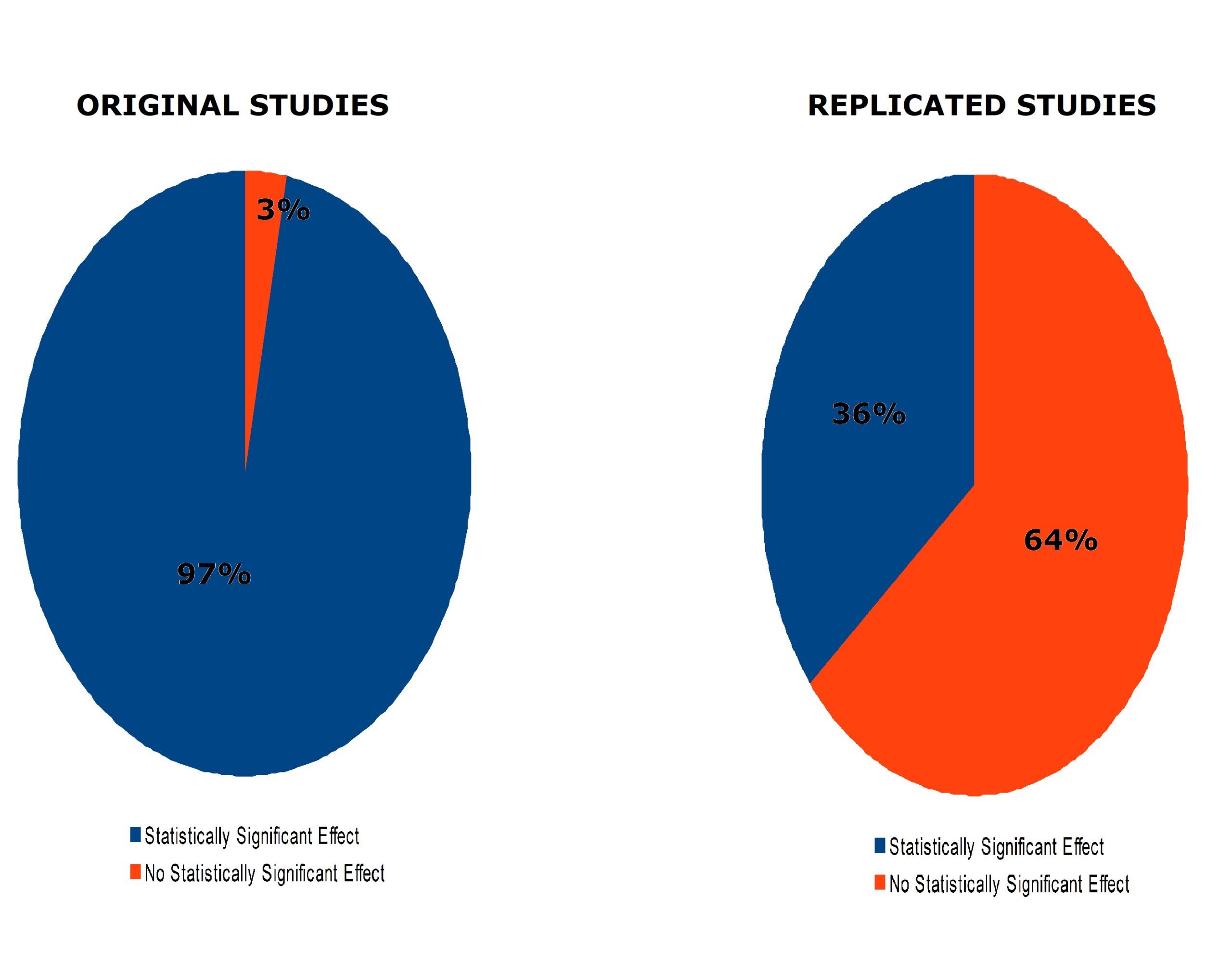
Although affective science (i.e., the study of affect, moods, and other phenomena related to emotions) is just one branch of psychology, the lack of agreement among scientists on how particular emotions such as happiness, fear, or anger should be defined and measured are not making the task of reproducing the results of emotion studies any easier. Why does it matter? If a published psychology study’s results cannot be reproduced by a different researcher and achieve the same result, then ultimately it damages the credibility of the journals and the academic field as a whole. It can also lead to results from one study being overgeneralized and leading to individuals being harmed as a result. What also makes the social sciences like psychology more difficult than hard sciences such as physics or chemistry is that the social sciences are measuring human behavior, which can be “less precise than measuring, for example, physiological markers such as blood pressure or heart rate” (excerpt from Replication Crisis). Human behavior typically involves human agency, and this introduces more things to consider that will of course complicate an hypothesis.
On the bright side, the replication crisis did appear to lead to some reform and more rigorous standards being adopted, such as calls for more stringent statistical methods, greater transparency in how studies are planned, and larger sample sizes (from Replication Crisis). Not surprisingly, this replication crisis was not without precedent. As Daniël Lakens observed, a replication crisis had happened nearly forty years earlier in the 1960’s and 1970’s before the one in the mid 2010’s (Concerns About Replicability Across Two Crises in Social Psychology). With any luck, or preparation, psychology and other social sciences will not face another crisis like this in the future. A unifying framework might even go a long way towards helping prevent another crisis. Another problem, however, sits in the way of this that must be addressed as well, as it actively contributes to the issue: The Toothbrush Problem.
The Toothbrush Problem
In regards to fragmentation (e.g., disagreement over how certain concepts are measured or over which theories to use) in psychology, this is often called the “The Toothbrush Problem,” a term coined by Walter Mischel that describes “researchers’ general resistance to using any theories but their own and their reluctance to build on someone else’s work” (excerpt from Remembering Walter Mischel (1930-2018)). Essentially, it is the idea that no self-respecting person would use someone else’s toothbrush to brush their own teeth as opposed to using their own toothbrush. This often leads to a surplus of theories and an abundance of two types of fallacies:
- The Jingle Fallacy: The tendency to “mistakenly believe two things are identical because they share the same label.” (excerpt from The Jangle Fallacy: Same Idea, Different Name)
- The Jangle Fallacy: The tendency to mistakenly “assume that two things are fundamentally different simply because they have different names. (excerpt from The Jangle Fallacy: Same Idea, Different Name)
Ultimately, the proliferation of Jingle-Jangle Fallacies leads to confusion and disorganization in the field as different terms are used to describe the same thing, or the same term is used to describe different things.
To a degree, for a time I thought I was at fault contributing to the Toothbrush Problem too. Most of the theories I was seeing early on when I began exploring the psychology of emotion had things that I liked about them, but none of the theories I was seeing had everything that I was looking for in it, so I set out to build my own model out of necessity, if for no other reason than to clarify my own thinking and thoughts on the subject matter. I figured that similarities could be drawn later. That is how Affect Engineering came into being.
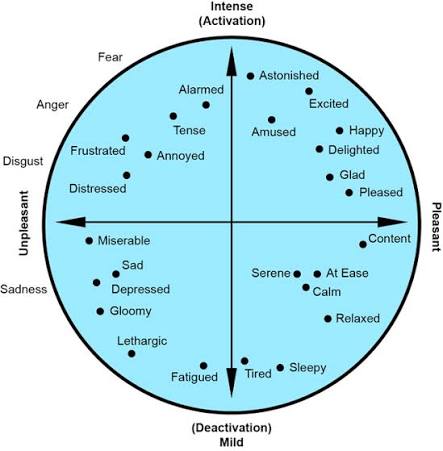
One model that I encountered early on in the Culture and Emotions class I took as an undergrad at Boston College (see Question #2 in On the Nature of Emotions: Additional Applications of Affect Engineering, Article 12 of 12), cited frequently among researchers, was James Russell’s Circumplex Model; it essentially maps emotions along two dimensions: Unpleasantness vs. Pleasantness (level of valence), and Activation vs. Deactivation (level of arousal)
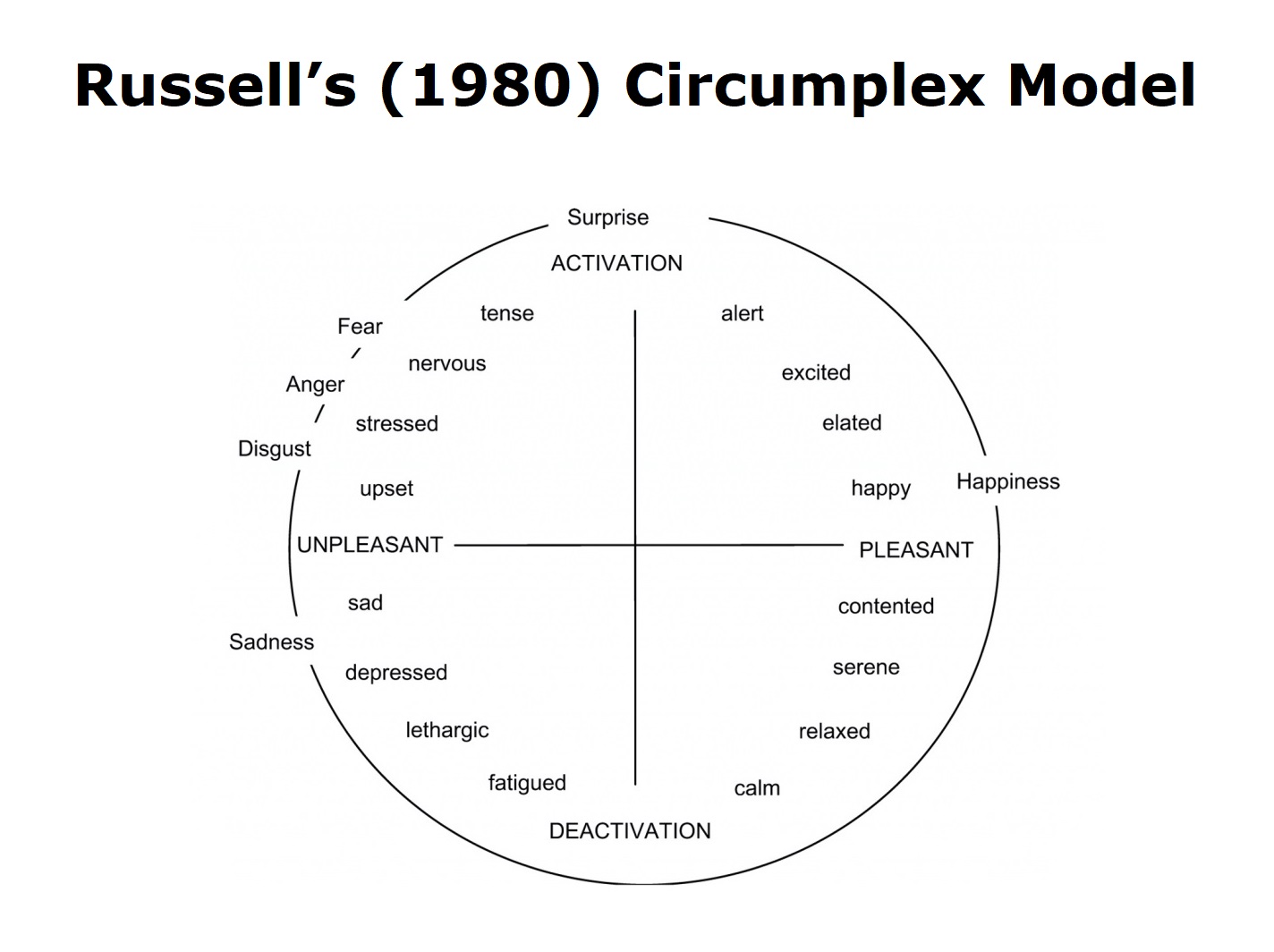
(from Russell’s Circumplex Models)
Below, is a more detailed layout of Russell’s Circumplex Model
(from Circumplex Model of Affect and Motivational State)
The Circumplex Model is also a mathematical model, and to a degree it influenced my own thinking on the subject and what was possible. However, in my mind at the time, its simplicity was both its blessing and its curse. While these two dimensions alone may have been enough to accurately identify some emotions, a part of me sensed that they may not be capturing the full essence of what they purported to measure. Additionally, I sensed that there were emotions concerning the self that they could not detect at all, such as helplessness, because of the limitations of two dimensions. For instance, suggestions for a third dimension, such as “dominance (feeling in control vs. feeling powerless), have been put forward, notably by Mehrabian and Russell themselves in the PAD (Pleasure-Arousal-Dominance) model” (excerpt from Russell’s Circumplex Model of Affect Explained). I wanted something more comprehensive. It also seemed like exploring anything involving empathy through this framework alone would be limiting, so I set forth on my own path.
As my own thought process evolved, eventually I saw how Russell’s Circumplex Model, and eventually other theories as well, could fit within my own framework. For instance, both dimensions of Unpleasantness vs. Pleasantness, and Arousal or Activation vs. Deactivation can be captured within Affect Engineering’s framework, but in different parts of the functions. In Affect Engineering, the y-axis handles information regarding pleasure and pain; pleasantness vs. unpleasantness would be mapped to occur in higher up mental processes (e.g., evaluations), while pain and pleasure would be mapped to occur in lower processes (e.g., sensory stimulation). While not a direct correlation to pleasantness and unpleasantness, this is at least a starting point.
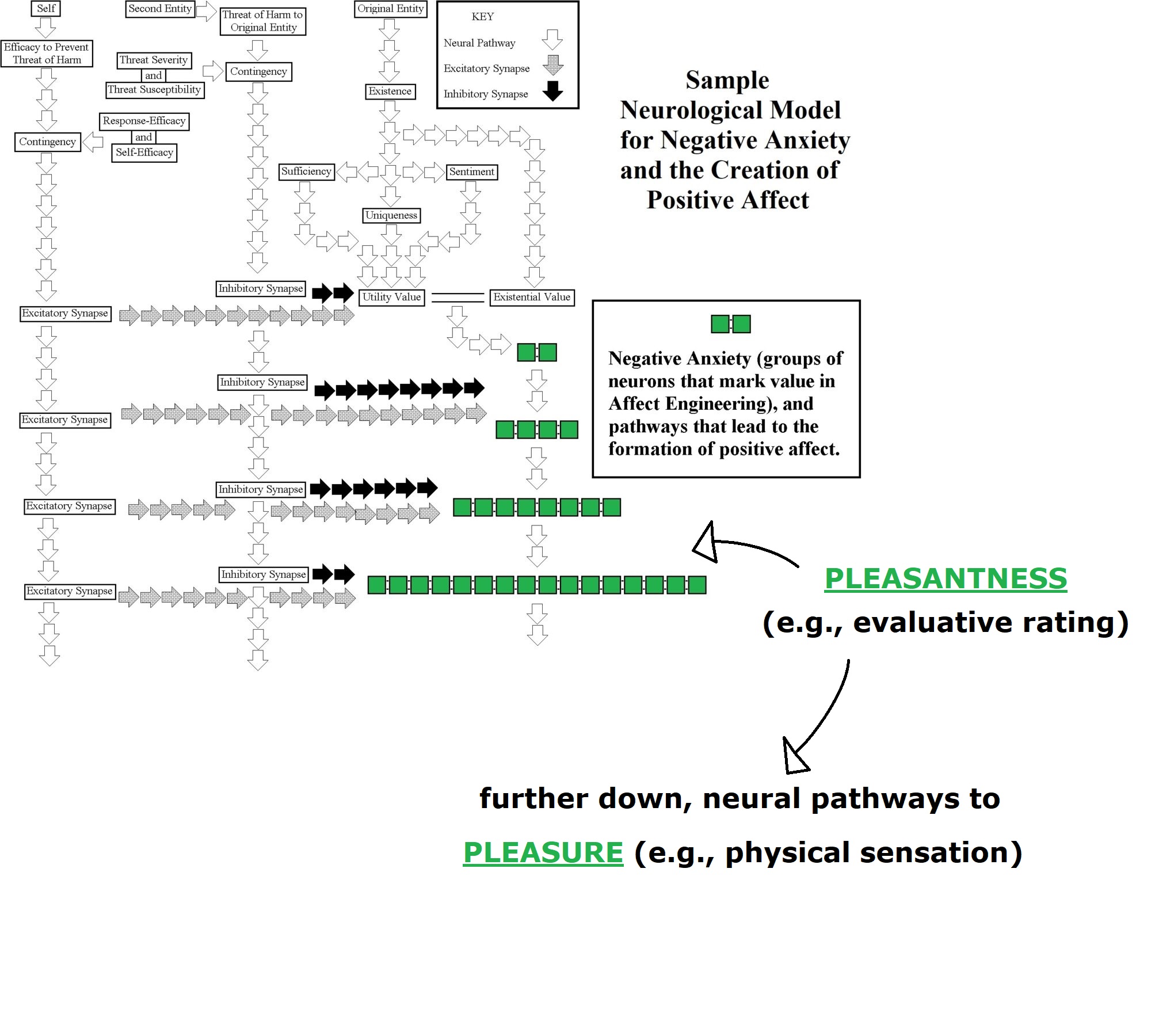
Neurological model of Pleasure and Pleasantness within Affect Engineering
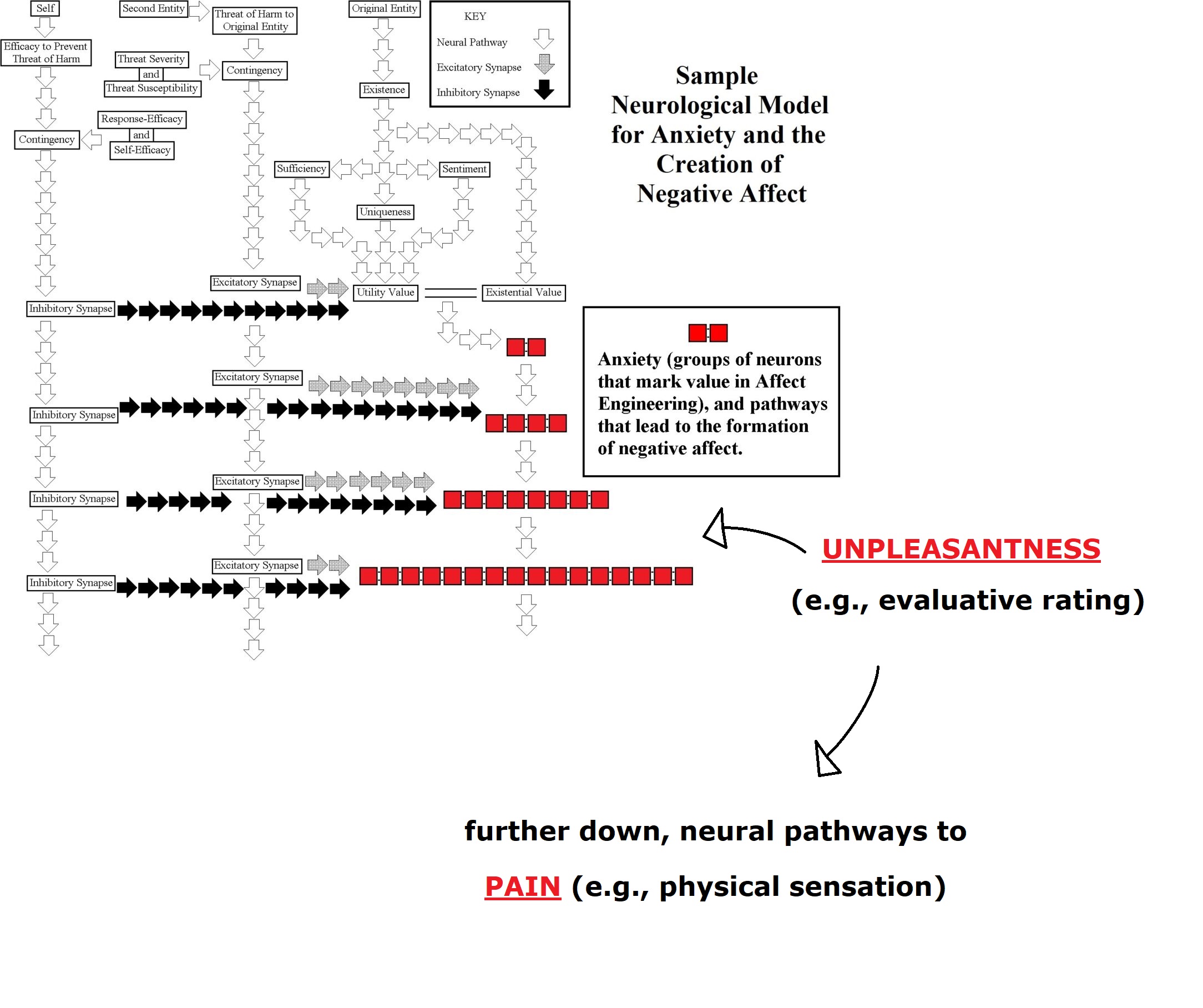
Neurological model of Pain and Unpleasantness within Affect Engineering
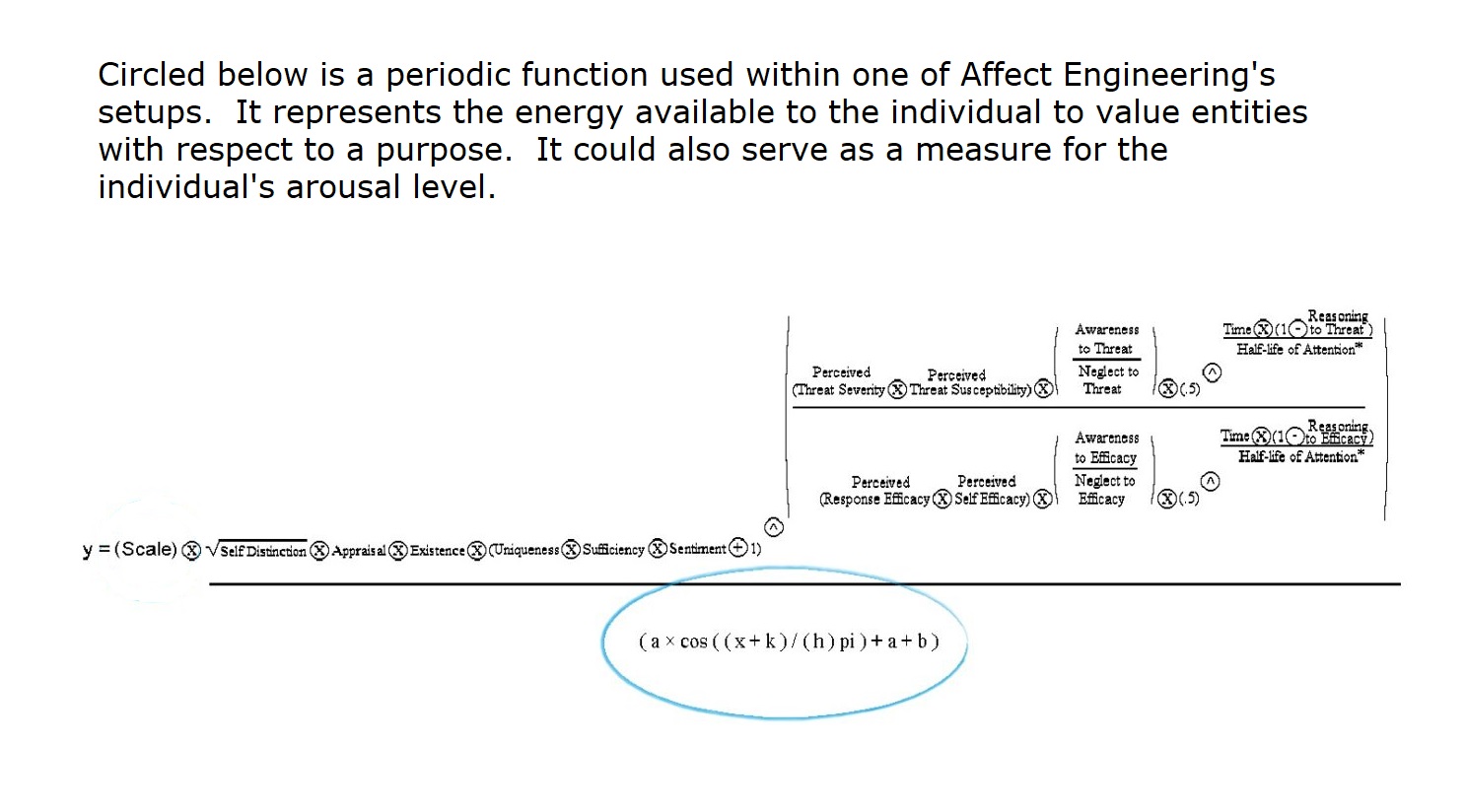
Arousal (e.g., activation vs. deactivation), or in Affect Engineering the overall energy available to the individual value entities with respect to a purpose, can be represented along trigonometric functions underneath an entire function. This was explored with biological rhythms in Question #4 of On the Nature of Emotions: Additional Applications of Affect Engineering, (Article 12 of 12). The latter, arousal, is not something I have always used to distinguish between emotions, but the possibility for doing so in Affect Engineering exists, meaning that emotions listed in James Russell’s Circumplex Model, could be fit into Affect Engineering’s framework if one desired to do so.
I mentioned that the simplicity of Russell’s Circumplex Model is both its blessing and its curse. As for Affect Engineering, it might alternatively be said that its complexity is both its blessing and its curse. There are six dimensions that I generally organize information around in Affect Engineering to keep it neat, but because most functions in Affect Engineering have at least sixteen variables, there are at least sixteen dimensions that are being considered (listed below), along with a seventeenth for different people if multiple people are being considered. If Arousal (i.e., Activation vs. Deactivation) from Russell’s Circumplex Model are incorporated, then this grows to at least eighteen dimensions, and more are certainly possible:
List of Variables (each can be considered a dimension)
- 1) y-value, or the valuation of the entity. This is a measure for affect, (e.g., positive affect and pleasantness, or negative affect and unpleasantness), and modeled neurologically to ultimately lead to feelings of pleasure or pain.
- 2) Self-Distinction (Whether the valuation involves Empathy vs. just the Self). This is a discrete variable
- 3) Existence of the Entity. This is usually modeled as a discrete variable (i.e., all or nothing, one or zero), but could be modeled as a continuous variable (e.g., between zero and one).
- 4) Uniqueness. This is a continuous variable.
- 5) Sufficiency. This is a continuous variable.
- 6) Sentiment, or importance of the purpose at hand. Essentially, Sentiment is representative of free will and serves as a wildcard variable for human agency within Affect Engineering. This is a continuous variable.
- 7) Perceived Threat Severity. This is a continuous variable. It is a concept borrowed from Ronald Roger’s Protection Motivation Theory.
- 8) Perceived Threat Susceptibility. This is a continuous variable. It is a concept borrowed from Ronald Roger’s Protection Motivation Theory.
- 9) Perceived Response Efficacy. This is a continuous variable. It is a concept borrowed from Albert Bandura’s Self-Efficacy Theory.
- 10) Perceived Self Efficacy. This is a continuous variable. It is a concept borrowed from Albert Bandura’s Self-Efficacy Theory.
- 11) Attention (there are several ways that this variable may be designed)
- 12) Elapsed Time
- 13) Reasoning to Threat (to hold Attention level on Threat components constant). This is a continuous variable
- 14) Reasoning to Efficacy (to hold Attention level on Efficacy components constant). This is a continuous variable
- 15) Half-life of Attention (alternatives include the Doubling Time of Inattention, and the Root-life of Attention)
- 16) Appraisal of the Entity (towards the restoration of equilibrium between a purpose and its complementary purpose). This is a discrete variable
- 17) The person (If functions are being modeled for different people being considered)
- 18) Trigonometric functions for Biological Rhythms that indicate Arousal Level
Notwithstanding, there are more dimensions that could be added if someone wanted to do so (e.g., variables that are coefficients modifying other variables in the functions, and biological rhythms), but this would ultimately depend on the researcher, what hypotheses they are testing, and what scenarios or concepts they are looking at.
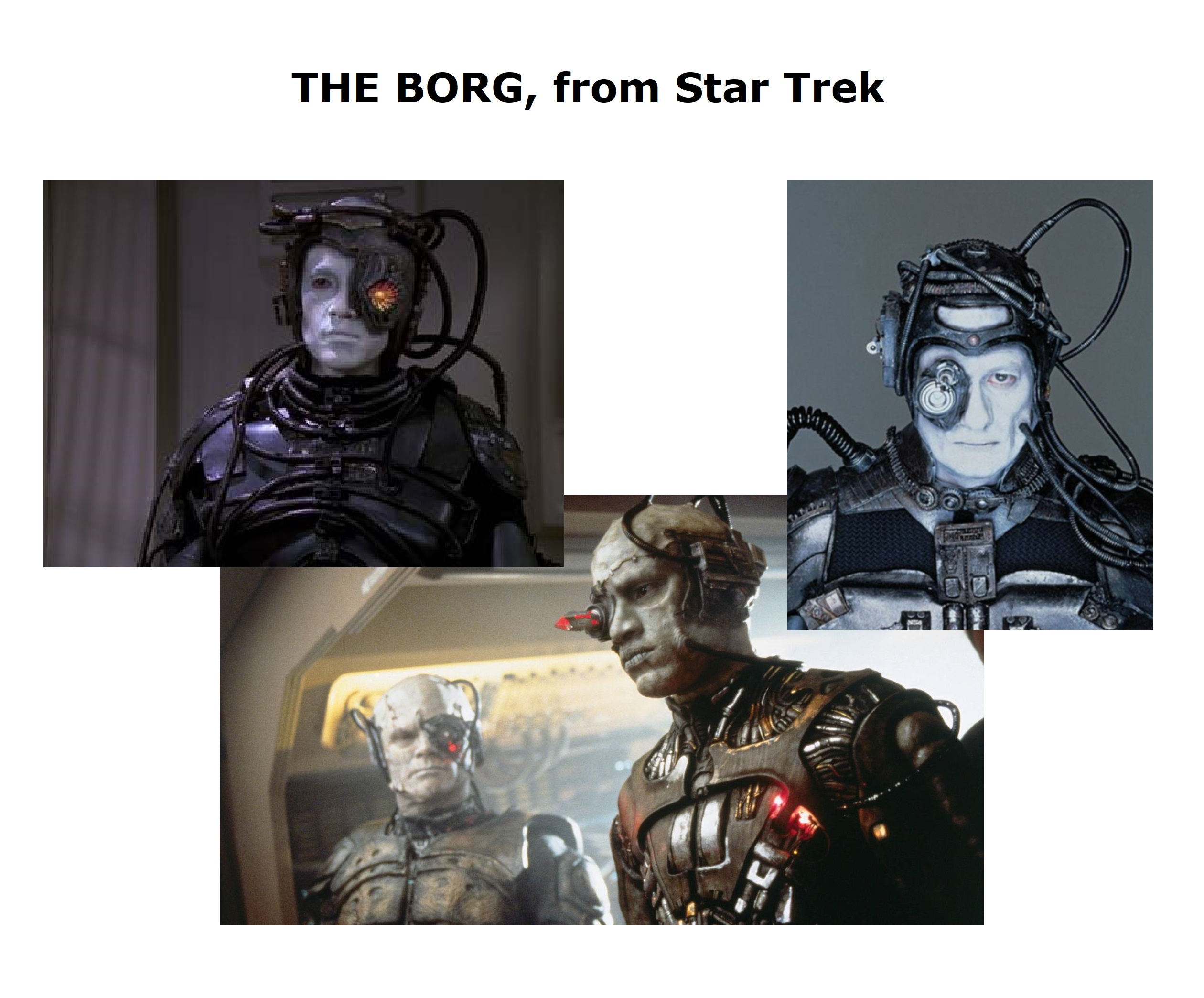
Ultimately, with respect to the Toothbrush Problem, I have come to see Affect Engineering as a lens through which to interpret and explain other theories of emotion. I do not tend to view other theories of emotions as rival theories, and have come to think of Affect Engineering as a tool, like a motorized toothbrush where the settings can be changed, or the head can be removed and replaced for two theories that would otherwise be incompatible (e.g., Basic Emotion Theory and the Theory of Constructed Emotion), but the handle and the underlying motor are the same for whatever toothbrush head is being used. To use a Star Trek metaphor, Affect Engineering is probably most equivalent to the Borg, a cybernetic hivemind that assimilates other species into it, except that Affect Engineering concerns with theories of emotion and is not particularly villainous.
As for projects that I have recently discovered such as the Human Affectome Project, “an international collaboration created in 2016 to address the problem of high variability in how emotions are described across fields and cultures in order to improve diagnosis and treatment of psychiatric disorders and increase understanding of human behavior and cognition,” I have no doubt they will achieve their aims eventually. Whether they do it by brute force or by a combination of math and logic is anybody’s guess.
3) How does Affect Engineering compare or relate to other theories of emotion?
At its core, Affect Engineering is a standardization tool that uses math to model emotions. Inevitably, people at some point or another tend to ask me if I have proven it yet. More amusingly, after reading what large language models have managed to scrape off of my website with their web crawling bots I will often see them assess that Affect Engineering lacks empirical testing.
In many regards, I often think Affect Engineering does not necessarily need to be proven in the traditional sense; it is a language at its core, and the only thing I aimed “to prove” with it was that emotions and concepts concerning them could be represented predominantly from a mathematical and logical perspective. From my point of view, asking me to prove that Affect Engineering can describe emotions is like asking a news reporter to prove that the English language can be used to describe what happened yesterday at the park. Most people would agree that English, or any other language for that matter (e.g., Spanish, French, Italian, Mandarin etc.), can describe what happened yesterday at the park, accurately enough to a degree that someone reading it might be fully capable of imagining everything that had happened as if they were there themselves, particularly if the writer is detailed and gifted enough with words. Or to put this metaphor in terms of computer languages, C++, Java, and Python do not need to be proven in order to be used effectively. Similarly, Affect Engineering does not need to be proven to be used effectively.
However, I do keep in mind that no amount of words can substitute for actually being there to witness what happened in the park in first place. Language is a re-creation, and fabricated on top of this. Or stated differently, one might say that reading about the Adventures of Huckleberry Finn will never be the same as being Huckleberry Finn living those adventures.

Mark Twain’s fictional novel The Adventures of Huckleberry Finn
The same can be said of Affect Engineering; it is a language designed to represent and transmit information about emotions through the language of math (e.g., as opposed to English). No matter how accurate it may be, at the end of the day numbers and words used to describe emotions can only help someone understand an emotion someone else or they themselves may be experiencing. They are not a substitute for being that person experiencing the emotion itself along with the situation. Even though Huckleberry Finn is a fictional work, the same applies to nonfiction. If I read someone else’s autobiography, I may learn a great deal about that individual and their past, but that does not mean that I have lived their life. A theory of emotion, no matter how accurate, cannot transform me into someone else to know their story firsthand.
Moreover, the psychology of emotion and other social sciences also deal with human agency, which is notoriously difficult to predict, if at all, and to a large degree, probably responsible for a lot of the difficulty in replicating studies in the social sciences in the first place. Free will is incorporated into the functions in Affect Engineering, via the variable of Sentiment. Making predictions with Affect Engineering and its functions, however, is only possible if this variable is held constant throughout (despite the likelihood that it would probably never be constant), or if one is a Behaviorist and considers concepts such as free will to be an illusion, in which case the variable would simply be eliminated from the function altogether. Despite these two viewpoints being incompatible (i.e., determinism vs. indeterminism), the possibility exists for someone to use Affect Engineering to model the formation of emotions from these two mutually exclusive viewpoints (e.g., indeterministic ones that permit free will, and deterministic ones like Behaviorism that exclude free will). This, serving as a standardization tool, is closer to the purpose I envision Affect Engineering serving. Proving whether one type of approach is more accurate than the other another is certainly something it can help with if one wanted to do so. As for proving itself, I would say Affect Engineering does not need to prove itself any more or less than a dictionary needs to prove it has words that mean other things.
PREVIEW
As a follow up to this article, my next post will go into more detail about how different approaches to the psychology of emotion can be integrated and into and represented in Affect Engineering. It will includes approaches from, but not limited to the following:
- Physiological Theories such as:
- James-Lange Theory
- Canon-Bard Theory
- Zajonc–LeDoux theory;
- Cognitive Theories such as:
- Lazarus’s Cognitive Appraisal Theory
- Schachter-Singer Two-Factor Theory
- Social Constructivist Theories such as Barrett’s Theory of Constructed Emotion;
- Evolutionary frameworks such as Basic Emotion Theory
This page is also listed under Additional Concepts and Relevant Articles